Now over 6000 Reviews and (near) Daily Updates!

WELCOME! Use the search engines on this site (or your own off-site engine of choice) to gain easy access to the complete MAKSQUIBS Archive; over 6000 posts and counting. (New posts added every day or so.)

You can check on all our titles by typing the Title, Director, Actor or 'Keyword' you're looking for in the Search Engine of your choice (include the phrase MAKSQUIBS) or just use the BLOGSPOT.com Search Box at the top left corner of the page.

Feel free to place comments directly on any of the film posts and to test your film knowledge with the CONTESTS scattered here & there. (Hey! No Googling allowed. They're pretty easy.)

Send E-mails to MAKSQUIBS@yahoo.com . (Let us know if the TRANSLATE WIDGET works!) Or use the Profile Page or Comments link for contact.

Thanks for stopping by.

Monday, October 10, 2016

THE QUIET MAN (1952)

Supreme contrarian that he was, it’s somehow appropriate that director John Ford’s biggest commercial success should be largely disparaged by many of his most doctrinaire academic defenders. Long a dream project for Ford, the film was just too popular, too Irish (make that ‘stage’ Irish), too pleasing (or corny) to stand with his more ornery classics; a misreading that still holds in auteur-ville. And while not exactly incorrect - it is very Irish, very likable - the objections (never a problem for regular film-goers) miss the main point of this story about an Irish-born/American-bred boy who returns to find the old homeland just as he imagined . . . and entirely different & foreign; told thru a series of encounters that test out Ford’s great post-WWII theme about the clash between legend and fact. It's famously articulated in the ubiquitous quote from THE MAN WHO SHOT LIBERTY VALANCE/’62: ‘When the legend becomes fact; print the legend.’ But it pays to remember that Ford consistently did the exact opposite; only to lie about 'the facts' he had just shown us. (Or if not bald-face lie, skirt the truth; seen most clearly at the end of FORT APACHE/’48 with John Wayne nimbly feeding the legend about his disastrous commanding officer, a Colonel Custer stand-in.) Here, Wayne spends most of the film falling into the divide between his blinkered romantic vision of Ireland, and the reality of entering what turns out to be a real, culturally mystifying place. Decked out with fabulist characters & visual design, the film triumphs as fable even when its TAMING OF THE SHREW elements jar.* Wayne & Maureen O’Hara are wonderful together, decidedly sexy; and the closing curtain call Ford arranges enchanting.

SCREWY THOUGHT OF THE DAY: *Thank goodness O’Hara is such a big strong gal and ‘gives as good as she gets.’ Elsewise, we couldn’t enjoy the delicious non-PC moment when an elderly local offers Wayne ‘a fine stick to beat the lovely lady.’

ATTENTION MUST BE PAID: Ford abruptly jolts us out of the film’s pastorale pace in a short & brutal flashback, done in silent German Expressionist style, to help explain Wayne’s character. Seeing Ford pull this visual tour de force out of a hat, and watching him effortlessly get-in/get-out in under a minute is awesome (and unexpected) stuff.

Sunday, October 9, 2016

HAIL, CAESAR (2016)

Three Hollywood luminaries of varying fame & wattage were said to ‘know where all the bodies were buried.’ All took their secrets to the grave. One was child (and ape) actor Roddy McDowall; the other two, M-G-M hair stylist Sydney Guilaroff & M-G-M studio ‘fixer’ Eddie Mannix. Enter the Brothers Coen (Ethan & Joel), out to make a sort of L.A. CONFIDENTIAL pastiche satire of ‘50s scandals & studio backlot skullduggery. Sounds fun, sounds right up Coen Snark Alley. Alas, they chose the wrong tour guide!; passing on hair-dresser confidant Guilaroff (knows all, tells nothing, takes on intractable problems & permanent waves) for infamous sweep-it-under-the-carpet/tough-guy Mannix. Kind of a flat creative decision, no? Well, it probably wouldn’t have mattered much, since the crises are either ho-hum or overly far-fetched (Commie Kidnap Conspiracy; Pregnant Unwed Swimming Star; Singing Cowboy Goes Drawing Room); and the pastiche song-and-dance; Aquacade; and Biblical Epic stuff not nearly as funny as the real thing. (Though one multi-hued set in the QUO VADIS take-off is gratifyingly hideous.) For the rest, Tilda Swinton is a treat playing twin gossip columnists not as Hedda Hopper & Louella Parsons, the forgotten models, but as Cate Blanchett. Hilarious! And Alden Ehrenreich charmingly lassos his way toward stardom.

SCREWY THOUGHT OF THE DAY/DOUBLE-BILL: The Coen boys find more legit laughs in their dramas than they do in ostensible comedies like this, THE LADYKILLERS/’04 or THE HUDSUCKER PROXY/94.

Saturday, October 8, 2016

ZOOTOPIA (2016)

Irresistible. Country Bunny meets City Fox in Zootopia, capital of a New Age World (more OZ than METROPOLIS) where predator & prey live in peaceful harmony. (In scale-adjusted neighborhoods to match various species.) The odd couple gimmick is that Bunny’s newbie cop and Fox’s two-bit street scammer are forced to work together to find out why some predator beasts are regressing into old savage ways. (With underlying race allegory playing out with minimal forcing, no one says ‘Can’t we all just get along,’ or anything like that.) Here and there, writer/directors Byron Howard, Rich Moore & Jared Bush fall into tired gagging (the Godfather shtick is awfully moldy by now), but most of their character, story & visual ideas are fresh, funny, suspenseful & exciting. Makes you wonder why more animated pics haven’t tried on the Police Procedural format: solid narrative structure; easy character introductions; built-in episodic/picaresque framework; plus, it lends itself naturally to sequels. Special kudos to Jason Bateman’s Fox in the vocal cast; and a tip of the hat to whomever thought of using comic legends BOB AND RAY’s Slow Talkers of America routine* for the sloths who run the DMV office.

LINK: *And here they are, probably from a 1980s TONIGHT SHOW appearance: https://www.youtube.com/watch?v=Qvrh73BVraE

SCREWY THOUGHT OF THE DAY: Another overly bright DVD, presumably to compensate for the image darkening in 3D projection systems (or is it from the glasses?). In any event, why they don’t readjust light levels for 2D home viewing is a puzzle.

Friday, October 7, 2016

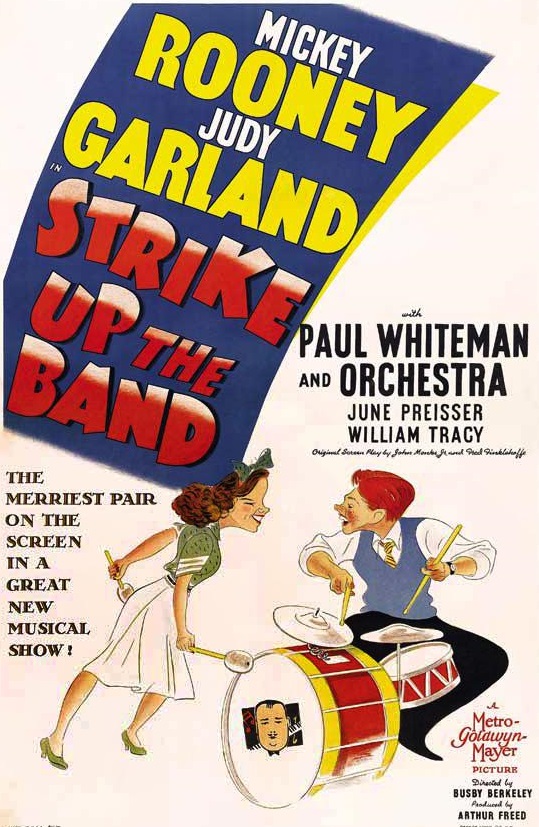
STRIKE UP THE BAND (1940)

This was the second, and weakest, of the four let’s-put-on-a-show musicals for Judy Garland & Mickey Rooney, early productions out of M-G-M’s Arthur Freed unit. Quickly turned out in the wake of the mega-successful BABES IN ARMS’/’39, it’s a High School Musical without the Depression & unemployment issues that shadow the earlier film. (Also without the BlackFace Minstrel Show.) In their place, a plot about rebooting the school band as a ‘swing’ outfit to win a gig on Jazz King Paul Whiteman’s radio show; story beats courtesy of puppy-love tiffs & ginned-up medical emergencies; but always making time for Rooney’s heart-to-heart guidance counseling from Mom or the nearest available surrogate parent. (Too bad none of them stopped him from padding the film out with two interminable reels of Old-Time melodrama.) Three numbers come off pretty well: Rooney & Co. in the superbly swinging ‘Drummer Boy;’ director Busby Berkeley showing some of his old form in geometric patterns on ‘La Conga;’ and a weird little stop-motion animation routine for fruits & vegetables thought up by visiting future director Vincente Minnelli. Garland looks & sounds adorable here, though very much subservient to Rooney who shows his multiple talents with less exhausting desperation than usual. Perhaps because the film story has so little at stake.

ATTENTION MUST BE PAID: The DVD’s cartoon-short, Rudolf Ising’s ROMEO IN RHYTHM, is an exceptional piece of animation, but take warning that the fierce racial stereotyping (shanty-town Black Crows in a ‘hep’ R&J parody) comes without any historical/cultural distancing.

DOUBLE-BILL: The title song is from an otherwise unrelated Gershwin musical, a flop political satire meant to follow OF THEE I SING. Why they didn’t find a spot for Garland to sing the show’s great ballad (‘I’ve Got a Crush on You’) is a mystery. No doubt, it sounded swell in the show’s original pit band which included Red Nichols, Benny Goodman, Glenn Miller, Jimmy Dorsey & Jack Teagarden, a group recreated in Anthony Mann’s GLENN MILLER STORY/’56 for the slightly later Gershwin show (also the last in the Judy/Mickey series) GIRL CRAZY.

Thursday, October 6, 2016

HELLO, MY NAME IS DORIS (2015)

Small & phoney, this well-received mismatched-couple comedy has to put blinders on all its characters to reach the finish line. A second feature for tv writer/director Michael Showalter, he’s happy to set up embarrassing comic situations & relationships, only to find himself out of his depth and teasing his way out of trouble. Here, lonely eccentric spinster Sally Field falls for the new hunk at work (Max Greenfield) leading to miscues in an unlikely friendship she thinks might turn romantic in spite of a two-generation age gap. In a French comedy (or a more dangerous American one), they’d get drunk, screw, then deal with the embarrassing consequences. But Showalter’s been nursing the tv teat too long to push against likability norms. Instead, plot beats & dramatic tropes substituting for real human foibles. And the basic idea that Field is so ‘unhip’ she’s ‘hip’ just isn’t enough to explain all her new relationships; her character runs out of steam halfway thru the pic. (Showalter tries compensating with a forced hoarding addiction subplot, presumably for some third-act catharsis/resolution.) A shame, since the lack of polish from the film’s small budget offers lots of believable texture and the leads are awfully good, though with extremely variable support. Showalter may simply be too facile for his own good.

SCREWY THOUGHT OF THE DAY: Bet you can quickly think of a dozen senior guy gets much younger gal (if only for a while) titles. Now, try and come up with an example where the genders are reversed.

Wednesday, October 5, 2016

THE ADVENTURES OF ICHABOD AND MR. TOAD (1949)

The Disney ‘gap’ years of animation purgatory (with collected shorts of varying quality doing service as features) came between BAMBI/’42 and the post-war renewal of CINDERELLA/’50. But a path out of the slump was in plain sight the year before in this little two-fer. Bing Crosby sings & narrates the main event (note the poster billing), a scary Hallowe’en ride from Washington Irving’s ICHABOD CRANE, and is very much in line with other well-made Disney ‘gap’ releases. But the real deal shows up in the opening segment, MR. TOAD’S WILD RIDE, taken from Kenneth Grahame’s children’s classic THE WIND AND THE WILLOWS (a kid’s book in rep only), featuring some of the best story & character animation seen at the studio in a decade. A riotous bit of anarchy about Toad’s serial manic enthusiasms, it’s got great gags; taut story construction; perfectly composed set pieces; a memorable gang of villainous weasels; loyal/lovable sidekicks; dizzying moments of gasp-inducing panic; even a moral for Toad to sabotage.  (Two missteps though: one of commission with those thieving weasels led by a Mr. Winkie; and one of omission in having Toad’s reckless id-driven chaos tamed as something of a frame-up.)  Any wonder this little film inspired the best ever ‘C’ ticket ride at the original DisneyLand? (Still operating? Still landing in Hades?)

DOUBLE-BILL/READ ALL ABOUT IT: As mentioned, Grahame’s THE WIND AND THE WILLOWS is more Lake Country pastorale than kiddie book, you’ll wind up reading for your own enjoyment. Such writing! And check out Terry Jones’ admittedly labored/labor of love full-length version (called MR. TOAD’S WILD RIDE/’96 Stateside) made with Monty Pythoners & others.

Tuesday, October 4, 2016

BLACK NARCISSUS (1947)

Writing/directing team Michael Powell & Emeric Pressburger, with lenser Jack Cardiff & production designer Alfred Junge, prestidigitated a stunning TechniColored Himalaya from the depths of a suburban London studio in this one-of-a-kind religioso-psychological thriller. Deborah Kerr is the Sister Superior, sent with a gaggle of Nuns to teach, farm and treat the body & soul of suspicious natives. Setting up shop in a mountain aerie palace once used to house concubines, Sister Kerr comes up against two unexpected road blocks, the manly, disdainful British trade agent (David Farrar sporting sexually provocative shorts) and worse, the increasingly exposed neuroses of her order (and herself) stuck inside Our Lady of Perpetual Neurasthenia. Farrar notes that there’s something in the atmosphere bringing it out, but the slightly ‘off’ quality really comes from the distinctive filmmaking of P&P (The Archers) who technically go their own way, giving many of their films a sort of handmade artisanal quality, especially in the arrhythmic editing. You’re always a wee bit off-balance under their charge. Sometimes this comes off as too much of a good thing, but here it works like a charm; a creepy scary sort of charm as Kerr fights off memories of a happy past life as well as the micro-society breakdown she’s supposed to be in charge of. While all thru the pic, the sheer audacious look of things remains a wonder to behold. How ever did they pull it off?! (Look for the recent, 2010, Criterion DVD upgrade with much improved color consistency & picture sharpness.)

ATTENTION MUST BE PAID: Powell brought in composer Brian Easdale to write the insistently active, game-changing film score using lots of vocal murmurs in the orchestral mix for storm & emotional highlighting, very Verdi/RIGOLETTO.

DOUBLE-BILL: The Archers followed this up with the unjustly overlooked SMALL BACK ROOM starring this film’s levelheaded David Farrar going a little off and crazed nun Kathleen Byron now acting as steadying influence.

Sunday, October 2, 2016

THE BIG HANGOVER (1950)

A specialist in glossy relationship comedies for B’way & Hollywood, Norman Krasna would occasionally direct his scripts. His first try, PRINCESS O’ROURKE/‘43, is a modest charmer, but this second attempt is D.O.A., a strange, sour sort of comedy with an anti-discrimination message tucked in for importance. (In its social concerns, it’s got Dore Schary, new co-head of M-G-M, written all over it.) Here’s the comedy part: Van Johnson, new man at a clubby, high-end law firm, has returned from the war with an alcohol problem . . . he’s allergic to the stuff. Recovering from battlefield wounds in a monastery that blew up, he nearly drowned in the friars’ brandy reserves and now goes blotto from any sort of spirits. But in his new job, he’s caught the sympathetic eye of Elizabeth Taylor, daughter of the law firm head, and she takes him on as a personal project. Krasna doesn’t do much with this painfully unfunny set-up, and makes things worse with spatially inert staging and stop-and-start pacing from his entire cast. As if no one wanted to pick up their cue to deliver the next deathless witticism. Here’s the message part: the firm’s working for a client who wants to keep a perfectly acceptable Asian doctor (and his pregnant wife) out of a new & costly housing complex. Johnson looks jusifiably pained throughout, while Taylor has yet to find an adult acting manner (she’d locate it over her next two films, FATHER OF THE BRIDE/’50 and A PLACE IN THE SUN/’51). Slim pickings all ‘round, other than figuring out who’s the mystery man playing Taylor’s dad. He’s Percy Waram, a B’way regular with scores of stage credits, but very few film appearances. A most uncomfortable film actor, he must have been a stand-in for an unavailable William Powell who’d play Taylor’s dad in another dud, his M-G-M swansong, THE GIRL WHO HAD EVERYTHING/’53.

SCREWY THOUGHT OF THE DAY: The film’s hardly a success, but Johnson’s alcoholic WWII vet in BRIGADOON/’54 cuts much closer to the bone (even with minimal screen time) than he does here.

Saturday, October 1, 2016

THE MAGNIFICENT SEVEN (1960)

After three sequels, a t.v. series and a new remake, it jolting to see John Sturges’ original (itself a redo in Western drag of Akira Kurosawa’s SEVEN SAMURAI) for the mediocrity it is. Occasionally, as in a sweeping action sequence with bandit horsemen riding thru town, or when the best of the gunmen hired to protect the town (Steve McQueen & James Coburn) try to top each other in sheer coolness (lanky Coburn walks away with it), you can see the fan appeal. But take away the famous Elmer Bernstein theme music (the sole magnificent thing in here*), and there’s a lot of dramatic dross and some surprisingly bad acting. Brad Dexter, forgettable as a dense fortune-hunting outlaw; Horst Buchholz, painfully inauthentic as the Mexican ‘Chico;’ Robert Vaughn, sincere in all the wrong ways. The remaining four certainly make their mark, but Eli Wallach’s villainous bandito still runs them off the screen. Likely it’s one of those films you need to see at the right impressionable age.

DOUBLE-BILL: As mentioned above, the Kurosawa original (trimmed by nearly an hour in the Stateside release that inspired this remake); OR: Check out how the socio-political changes of the ‘60s helped Sam Peckinpah & Co. blow this to smithereens in THE WILD BUNCH/’69.

SCREWY THOUGHT OF THE DAY: *Marlboro Cigarettes imprinted Bernstein’s bold theme on a couple of generations, but his next Western score, THE COMANCHEROS/’61, may be even better.