Now over 6000 Reviews and (near) Daily Updates!

WELCOME! Use the search engines on this site (or your own off-site engine of choice) to gain easy access to the complete MAKSQUIBS Archive; over 6000 posts and counting. (New posts added every day or so.)

You can check on all our titles by typing the Title, Director, Actor or 'Keyword' you're looking for in the Search Engine of your choice (include the phrase MAKSQUIBS) or just use the BLOGSPOT.com Search Box at the top left corner of the page.

Feel free to place comments directly on any of the film posts and to test your film knowledge with the CONTESTS scattered here & there. (Hey! No Googling allowed. They're pretty easy.)

Send E-mails to MAKSQUIBS@yahoo.com . (Let us know if the TRANSLATE WIDGET works!) Or use the Profile Page or Comments link for contact.

Thanks for stopping by.

Monday, September 21, 2009

WAY DOWN EAST (1920)

It’s the mother-of-all melodramas, and wiseguys have been scoffing at its old-fashioned ways & means since before it was released. Even its star, Lillian Gish, ‘What? That ol’ thing?’ But D. W. Griffith pulled it off with a combination of showmanship (particularly in the use of real & very dangerous locations); film technique (especially in the clear editing of parallel storylines); and his complete belief in seemingly inert material. Gish is just about perfect as the naive girl who’s tricked into a mock marriage and then loses her newborn child. Friendless & wandering, she stumbles into a new life at a country estate (with a handsome son, natch) when her old nemesis shows up. So close to redemption, so close to finding love, so close to a chance at happiness! And then, the man who got her into all this trouble turns out to be the well-liked gentleman neighbor. Cue the Ice Storm! As the farmer’s son who quickly falls in love with Gish, young Richard Barthelmess is disarmingly open-hearted & intimate which brings out a new sensuous note from Gish while Lowell Sherman makes his seducer villain almost shockingly nonchalant. There’s an awful lot of rural comedy in the supporting roles, far too much in the case of Martha, the town gossip, but it gets a surprising amount of laughs (there’s a hilarious Post Office porch tableaux), and it works as mortar to help shore up the melodramatic bricks. The last three reels play out as a thrilling series of climaxes, including the legendary/gasp-worthy rescue on the ice floes sequence. The superb restoration on KINO from the MoMA archives is tinted too darkly, but it’s by far the most complete edition since . . . well, since 1920, and the varying print quality (from very good to pretty rough) makes for a nice little history lesson in film preservation.

Saturday, September 19, 2009

MOON OVER MIAMI (1941)


All the Hollywood studios made three-girls-on-the-make pics, but 20th/Fox had an absolute mania for the formula. This iteration finds Betty Grable, Carole Landis & Charlotte Greenwood moving from Texas to Miami to grab a millionaire. Grable poses as an heiress and lands two suckers, Don Ameche & Robert Cummings while Landis & Greenwood give support. Fortunately, when Jack Haley uncovers the scam, the scheme’s collapse releases everyone to pair up romantically. Dance director Hermes Pan really puts Grable thru her paces on this one (she's more than up to the challenge) and he worked out a bright routine for Greenwood & Haley; even Ameche & Cummings show some charm under Walter Lang’s sympathetic megging. But the Ralph Rainger/Leo Robin songs fall flat and nothing sticks in your memory.

Thursday, September 17, 2009

VOLVER (2006)

After his breakthru with WOMEN ON THE VERGE OF A NERVOUS BREAKDOWN/’88, Pedro Almodóvar lost his stride by overindulging the very character, stylistic & narrative eccentricities that had ‘made’ his rep. So, it’s a relief to see him pull back from the heavy metaphysics of his stellar recent work with this relatively ‘straight’ story that could easily be titled ALL ABOUT MY MOTHER II. And how nice that Carmen Maura, his early muse, is back after twenty years to pull it off so movingly. Penelope Cruz leads a great cast in a twisty murder/revenge/redemption tale that any MILDRED PIERCE/’46 fan should respond to. Female empowerment, second chances, patricide, second sight; all the expected Almodóvar themes wrapped in his highly colored visual scheme and immaculate craftsmanship. The editing is quite exceptional. And from the opening shot of women tending their cemetery plots, you feel the confident hands of a master filmmaker with the wisdom & maturity to know when to trim his sail.

Wednesday, September 16, 2009

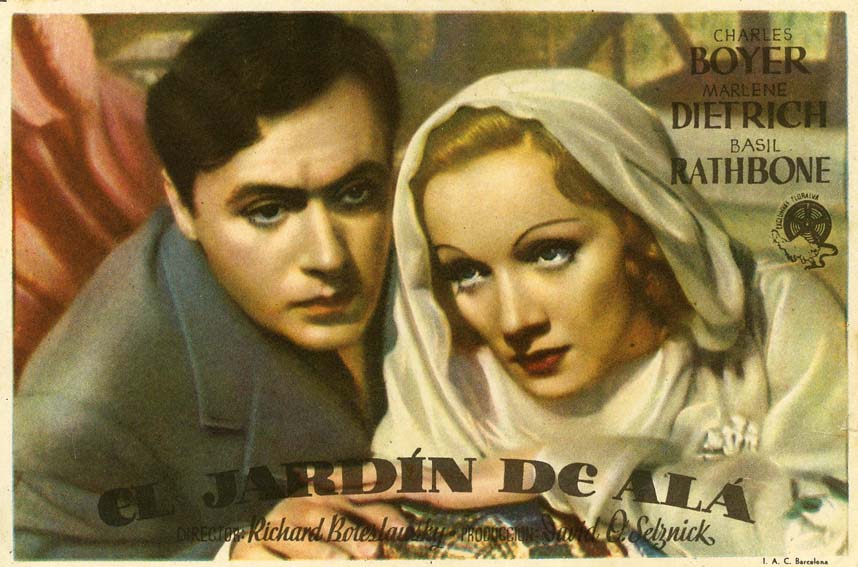
THE GARDEN OF ALLAH (1936)

David O Selznick’s second film as an independent producer, one of the early triumphs of the still new three-strip TechniColor process, remains breathtakingly beautiful as artifact and breathtakingly silly as drama. But who would want it otherwise? Dressed appropriately in a series of glamorous, flowing pastel chiffon outfits, Marlene Dietrich heads to the desert to purity her unhappy soul. There, she falls for dewy, doe-eyed Charles Boyer and they marry before she discovers his terrible secret; he’s a monk on the lam. Will the secret of the monastery’s famous liqueur be lost forever to secular passion? Will Basil Rathbone’s romantic arab prince reveal all? Will Tilly Losch’s lap dance unnerve Boyer? Will Joseph Schildkraut lose Dietrich’s luggage? There’s so much at stake! You really can’t make fun of kitsch this pure. And don’t kid yourself, underrated helmer Richard Boleslawski, originally a member of Stanislawski’s Moscow Art Players, knows the score. Just let it roll over you like the Max Steiner music that looks toward Sigmund Romberg’s THE DESERT SONG for it’s own brand of Golden Age Hollywood authenticity.

Tuesday, September 15, 2009

PRETTY POISON (1968)


Anthony Perkins gives one of his best post-PSYCHO/’60 perfs as a paroled felon with lingering mental problems who finds relief from his mind-numbing factory job (and his violent past) by indulging in a dangerously active fantasy life. He meets cute/impressionable/underage Tuesday Weld and finds a romantic partner willing to play along with his fictionally constructed secret life as a CIA agent. (Just how much of this fantasy she believes is open to question.) At first, Lorenzo Semple’s script plays like an off-kilter WALTER MITTY tale or perhaps an Americanized BILLY LIAR, where doses of illusion help to break the monotony of an average life. But the story swerves into darker territories as nihilistic actions allow Weld to force Perkins into dramatic corners he either can’t or doesn’t wish to get out of. The film just gets weirder and better as it goes along, even if the brief visual feints toward New Wave editing from megger Noel Black don’t quite come off. He’d soon settle into routine tv work. But the film deserves its growing cult following as does that cute blue Sunbeam that Tuesday Weld gets to drive. Yum, what a sweet car!

Monday, September 14, 2009

UMARETTE WA MITA KEREDO / I WAS BORN BUT . . . (1932)

Just before Talkies reached Japan, Yasujiro Ozu won three consecutive Best Picture awards beginning with this startlingly funny domestic comedy, taken from the same source material he would reconfigure as GOOD MORNING/’59 late in his career. It’s about two young brothers who’d rather play hooky than face all those bullies at their new suburban school. Naturally, their dad finds out what’s going on and sees that they return to class. Soon, the brothers have managed to turn the tide of peer pressure in their favor with their schoolmates, but at the same time they’ve become increasingly aware of how their father bows & scrapes, rather than confronts, similar obstacles at his workplace. What’s the point of gaining neighborhood bragging rights when you know your father is a wuss? While largely focusing on the fights, friendships & shifting allegiances of the kids, Ozu touches on broader issues, all within a story line & comic sequences that could have come from an OUR GANG short. Though the dramatic balance of GOOD MORNING, along with much of the distinctive Ozu directorial style has yet to crystalize, and his use of parallel editing between kids at play & Dad at work is too simplistic, the film remains a breezy delight with a thoughtful third act that enriches all the hijinks without seeming to change gears.

Sunday, September 13, 2009

INDIANA JONES AND THE TEMPLE OF DOOM (1984)

It turns out that neither helmer Steven Spielberg nor producer George Lucas have much affection for the joyless, over-produced prequel they made three years after the infinitely superior RAIDERS OF THE LOST ARK/’81. Their distaste, as seen on the DVD-Extras, is unusually frank, but it’s hard to disagree with them. The passing years have only emphasized the film’s faults. Harrison Ford is still pitch-perfect as Indiana, but nothing else matches the kind of kidding-on-the-square attitude that defined the original. The GUNGA DIN style plot feels like small potatoes after taking on the Nazis; the stunts and gross-out humor are all bark & no bite; and poor Kate Capshaw fails to delight as the romantic feminine nuisance. Worse yet, you can’t properly ‘read’ any plausibility into the big action sequences which is what made the death-defying escapes in RAIDERS so much fun to watch. No wonder those boys bad-mouth this one.

Saturday, September 12, 2009

AFFAIR IN TRINIDAD (1952)


After four years as Mrs. Aly Khan, Rita Hayworth returned to Columbia Studios and was hustled into this GILDA/’46 retread. Well, half GILDA and half shameless rip-off of Hitchcock’s infinitely greater ‘46 noir NOTORIOUS . Charles Vidor, who made GILDA, was working @ Goldwyn, so Vincent Sherman megged. Sherman specialized in handling stars with career troubles, but he tended to make things worse. Bette Davis, Errol Flynn & Joan Crawford had all stumbled under him, now it was Rita’s turn. And that was a shame because Rita came back in good shape and eager to play. She’s a nightclub performer who finds herself up to her neck in an international arms conspiracy when her husband turns up dead. Thank God, this gal can still toss her hair back and swing like crazy with the band on a number or two. Glenn Ford, all smoldering sex in GILDA, is stuck in a chump role as the clueless brother of Rita’s murdered husband. B’way actress Valerie Bettis, who’s a bit like Gena Rowlands, stands out among the conspirators as a good-time gal with a weakness for liquor. She’s an obvious talent, but proved tough to photograph and beat a quick retreat from L.A.. Rita kept at it, but the glory days were gone.

DON KIKHOT / DON QUIXOTE (1957)

Knowing how directors like G. W. Pabst, Orson Welles, Terry Gilliam & Arthur Hiller(!) all failed (in one way or another) at getting Cervantes’ epic up on the screen does give this Grigori Kozintsev prestige pic the advantage of lowered expectations. The Soviet helmer, best known for weighty adaptations of HAMLET/'66 and KING LEAR/'71, turned out a handsome product, well-paced, with a clear-eyed take on the story. He maintains enough complications to keep the woeful knight from becoming a ‘wise’ madman cliché and had the hefty budget and generally fine cast to back him up. The Sancho Panza hams things up (don't they all), but Nikolai Cherkassov, Sergei Eisenstein’s Nevsky & Ivan, makes an exceptional, absurdly elongated 'Kikhot.' If only Kozintsev weren't so bi-polar behind the camera, with beautifully rendered location shooting wedding landscape to character & action, then staging his busy interiors with all the finesse of a third-rate touring opera company. Still, it may well be the best feature-length Quixote out there, and the Ruscico-DVD is more than acceptable. By the way, don’t worry that you missed the windmill sequence, it’s been moved toward the end and to their credit, they don't overmilk it. Along with the court scenes, where the formal behavior of the grandees and 'Kikhot's' humiliation are perfectly matched with Kozintsev's stiff WideScreen compositions, it's the best realized sequence in here. (Set the audio on the mono track to improve the echo-chamber sound.)