Now over 6000 Reviews and (near) Daily Updates!

WELCOME! Use the search engines on this site (or your own off-site engine of choice) to gain easy access to the complete MAKSQUIBS Archive; over 6000 posts and counting. (New posts added every day or so.)

You can check on all our titles by typing the Title, Director, Actor or 'Keyword' you're looking for in the Search Engine of your choice (include the phrase MAKSQUIBS) or just use the BLOGSPOT.com Search Box at the top left corner of the page.

Feel free to place comments directly on any of the film posts and to test your film knowledge with the CONTESTS scattered here & there. (Hey! No Googling allowed. They're pretty easy.)

Send E-mails to MAKSQUIBS@yahoo.com . (Let us know if the TRANSLATE WIDGET works!) Or use the Profile Page or Comments link for contact.

Thanks for stopping by.

Tuesday, April 10, 2012

CAPTAIN AMERICA (2011)

More derring-do from the Marvel Comics catalogue, but without the usual self-referential snark, hip attitude or pointless CGI overkill. Instead we get, of all things, a ton of charm. It has to be squeezed in, between all the fights & explosions, but still . . . such a pleasant surprise. The prologue in particular is a dandy piece of pop entertainment, with Chris Evans proving the most winning superhero since Chris Reeve donned a Superman suit. As Steve Rogers, a patriotic 90-lb weakling who needs to pass the army physical before he can fight the Nazis, he ‘wears’ a remarkably convincing stunt body (with computer assistance) before getting pumped up permanently as Captain America. But the performance is all his. This early section is beautifully designed; layered with respect & affection for period style and even some old style filmmaking. (Are they really shooting such a big ticket item on Paramount's 'standing' backlot NYC set? Good for them!) There’s little chance of maintaining this level of innocence & heartfelt sentiment once our boy gets super-charged (the basic set up is completely tone-deaf with the ‘good guys’ beating the Nazis thru genetic engineering!), but everyone in the big cast is pitch-perfect, ‘kidding on the square’ to fine effect. (Kudos to Sebastian Stan as the best bud, he scores in a thankless part.) No doubt it’s helmer Joe Johnston who keeps things from overloading and, even more importantly, relocates the sense of visual fun he had way back on THE ROCKETEER/’91. NOTE: Our poster is from a 1944 15-part serial you can see on YouTube. The graphic style matches up with the cool period posters used in the film's nifty End Credits.

SCREWY THOUGHT OF THE DAY:  Watch for a ‘lift’ from Powell/Pressburger’s great WWII fantasy A MATTER OF LIFE AND DEATH/’46. It’s the scene where the plane’s going down, but the pilot keeps talking to the girl over the radio. The whole creative crew pitches in to make it sound just right and look just right, with deliciously rich color saturation levels that mimic TechniColor.

DOUBLE-BILL:  Alas, this film is a big set-up for an upcoming super-colossal All-In-One Super Hero mega-pic, THE AVENGERS. Talk about overkill. Why not see how Johnston’s THE ROCKETEER holds up. Or check out A MATTER OF LIFE AND DEATH for the ‘lifted’ scene. (It’s near the opening.)

Monday, April 9, 2012

HAK GAM / ISLAND OF GREED (1997)

Stateside followers of Asian actors like Andy Lau & Tony Leung Ka Fai (not to be confused with Tony Leung Chiu Wai) naturally associate them with the small percentage of their work that finds U.S. distribution. But with well over 100 titles for each, baskets of local product (mostly Taiwanese/Hong Kong) never gets over here. At least, not on legit DVDs with intelligible English subtitles. This one, from the brothers Mak, producer Johnny & megger Michael, helps fill the gap, but with a truckload of empty action calories. There seems to be a decent budget on it, but this typical actioner remains disposable stuff, loaded with guns & broads, explosions, flying attacks & lots of ‘yuck-yuck’ comic relief. In fact, it’s sillier than it has to be since the basic story of gangs & political corruption reaching all the way to the top of the Taiwanese police & government isn’t so far-fetched. (Just at the moment, it’s a big story over in Mainland China.) In this one, Leung is the fast-rising mob man who's running for political office while Lau plays the incorruptible investigator. They're both fine, but the Maks can’t be bothered to put two and two together for a readable action sequence. They’d rather just throw disconnected shots of mayhem around. (There is, however, one inspired bit involving hundreds of guard dogs running thru acres of cultivated farm land.) Still, the levels of destruction are impressive and the film is never less than watchable even if the actual DVD transfer isn’t as good as it might be. All told, a bit of a waste considering the production values and story potential. The Mak Brothers haven’t made a pic since.

WATCH THIS, NOT THAT: Tony Leung Ka Fai gets a lot more out of similar situations in ELECTION/’05 and Andy Lau, though best known over here for historical epics, really shows his stuff in INFERNAL AFFAIRS/’02, a tightly plotted Cop vs Mob tale that Martin Scorsese puffed up into THE DEPARTED/’06.

Sunday, April 8, 2012

WERCKMEISTER HARMONIES (2000)

In a small, isolated village in Hungary, one of the town’s leading citizens fixates on the superiority of musical scales before they became ‘well-tempered.’ His ex-wife (Hanna Schygulla, of Fasssbinder fame) vows to return home unless he agrees to head a better government panel. His nephew/caretaker (a very fine Lars Rudolph) leads tavern habitués in a dance that demonstrates the lunar eclipse, before heading off to play general factotum & holy fool to the community at large. Then the circus comes to town. Not with the usual clowns & acts, but with a decayed whale as sole attraction. From such unexpected, even unrelated parts, Hungarian master Béla Tarr shows how thin a membrane civilization lives by, and how the moral equilibrium that holds a social order in place can rupture. Shot in uncomfortably long takes, Tarr’s slow-crawl tracking shots & phenomenal eye for monochrome composition help this challenging film fest fare live up to the hype. A compelling, mysterious fable of dread & escalating violence, it’s both inexplicable and unforgettable, as if Samuel Beckett had gone to film school in Pest . . . or perhaps Buda.

Friday, April 6, 2012

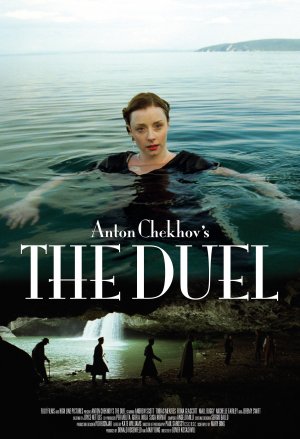
ANTON CHEKHOV’S THE DUEL (2010)

This adaptation is more National Theater than Moscow Art Players; taken from a novella that feels more Pushkin than Chekhov; and topped with a fumbled climax. But this ensemble piece about drifting Russians trying to sort out romance, friendship & entanglements at a Baltic coastal town is lively & involving all the way thru. Something of a companion piece to Chekhov’s THE LADY WITH THE DOG/’60, which got an all-Russian film treatment that nails tone & carriage without ever quite springing to life; here, the pluses & misses of that production are neatly reversed. Not a bad tradeoff. As the dreaming layabout who quaffs, bets and wants to abandon his mistress (now that her husband has died and made her all too available), Andrew Scott’s shlubby attire & careless grooming, can’t alter a performance that’s too tidy by half. As his nemesis, Tobias Menzies works too hard to prove that his arrogant scientist is a decent sort of chap. His rational outlook needs to be maddeningly sane. Yet, you wind up caring for them both. (Chekhov, ya know.) Fiona Glascott, as the lady in question, who’s equally wronged and wrong, is mesmerizingly right, with a malleable look that surges & ebbs to fit every situation. The ending, which is crucial since it reshuffles the cards for just about all the major players, is a serious miss by Israeli director Dover Koshashvili, but you can always read the novella to clear up any confusion. Better yet, read it first.

DOUBLE-BILL: As noted above, THE LADY WITH THE DOG to see all the particulars done ‘just so.’

READ ALL ABOUT IT: As mentioned, the Chekhov original.

Thursday, April 5, 2012

SECOND HONEYMOON (1937)

In the middle of your second honeymoon, the last person you want to run into on your hotel balcony is your Ex. Especially when Hubby #2 is too much the solid citizen and Hubby #1 still sets off the old chemical reactions. It’s kisses & spats until you succumb to the inevitable. Noël Coward’s PRIVATE LIVES? No such luck; it’s a misbegotten lunge at sophisticated marital comedy for Tyrone Power & Loretta Young and a cast of not-so-funny farceurs in this Fox programmer. (Poor Claire Trevor gets featured-billing, but nothing, nothing to do.) The stars revel in their dewy youthful beauty, but can’t do a thing with ersatz ‘rom-com’ zingers & quick reversals that are more WILL AND GRACE than NOËL AND GERTIE.

WATCH THIS, NOT THAT: You can hear the real thing with Noël Coward & Gertrude Lawrence in extended excerpts from PRIVATE LIVES, including the scene where they sing ‘Someday I’ll Find You,’ with Gertie wandering off pitch in her usual alarming manner. (Imagine Gershwin, Richard Rogers, Kurt Weill & Coward all writing classics for that wayward instrument. Amazing.) Or try M-G-M’s PRIVATE LIVES/’31, an early Talkie smash with Norma Shearer (pretty good) & Robert Montgomery (very good).

Wednesday, April 4, 2012

MEEK’S CUTOFF (2010)

Critical darling Kelly Reichardt (OLD JOY/’06; WENDY AND LUCY/’08) moves as deliberately as ever in this quiet annoyance. She’s still wandering into the wilderness, but this time in period setting directing a tiny band of wagoneering pioneers as they follow their increasingly unreliable guide. Running low on supplies & beginning to harbor mutinous thoughts, they come across a lone (lost?) Native American. Could this stranger in a strange land know a better route? Or will he lead them to slaughter? That is, if their miffed braggadocio-of-a-guide doesn’t shoot the man from race hatred, spite or jealousy. Reichardt starts right in the middle of the story, but even moving at a snail’s pace, you never get much of a handle on the characters. Or perhaps it's just that the fine cast (Michelle Williams, Paul Dano, Will Patton) promise more than her one-note creations can deliver. There’s something fusty in the laconic dialogue, unreadably dark night-time shooting & even in the use of Academy Ratio framing. It's an artistic discipline that functions more like a hair-shirt than a spur to creativity, before she pulls the plug with a Lady-or-the-Tiger tease ending.

WATCH THIS, NOT THAT: John Ford’s WAGON MASTER/’50-meets-Nicolas Roeg’s WALKABOUT’71 sums up and improves on this. But if it’s 'Westward-Ho' pioneering you’re a’hankering for, there’s James Cruze’s hit silent THE COVERED WAGON/’23 or Raoul Walsh’s stiff early Talkie flop THE BIG TRAIL/’30, physical touchstones to the past in spite of much melodrama.

Tuesday, April 3, 2012

THIS ABOVE ALL (1942)

Eric Knight’s ‘daring’ British-based WWII novel must have been tamed considerably for this plush, moody romancer between upper-crust beauty Joan Fontaine & chip-on-his-socialist-shoulder soldier boy Tyrone Power. The story has Joan ditching her stuffy family to join the WAAFs as a Private while Ty, who’s fending off an incipient nervous breakdown after heroic service in France, goes AWOL. In their only pic together, Power & Fontaine make quite the handsome couple (she’s just spectacularly lovely), but helmer Anatole Litvak isn’t able to help much on her crucial uplift speeches; too busy fighting a losing battle against the airless soundstage exteriors that undercut her hearth & homeland theme. Maybe that’s why the film is at its best during the blackout scenes where master lenser Arthur Miller, fresh off of John Ford’s HOW GREEN WAS MY VALLEY/’41, gets to shoot darker than ever. The following year, Knight’s LASSIE COME HOME became a sensation, but the author died in a fighter plane which makes this one even more of a missed opportunity.

WATCH THIS, NOT THAT: For that ‘sceptered isle’ patriotic glow, grab Laurence Olivier’s classic HENRY V/’45. That’s the message Fontaine is trying to get across here even though the film’s title is from HAMLET.

Monday, April 2, 2012

THEY MET IN BOMBAY (1941)

Before Pearl Harbor redefined the political landscape, Hollywood tended to tiptoe into the troubled international scene by bending the formulas of genre pics, twisting tropes like pretzels to serve new purposes. It helped give protective ‘cover’ against non-neutrality charges, but also made for odd bedfellows, as in this pic where near-schizophrenic plot-turns become both dramatically ridiculous & politically fascinating. Act One, finds Clark Gable & Rosalind Russell meeting-cute & ‘scoping-out’ the Bombay scene as rival jewel thieves. By Act Two, they’re joined at the hip and on the run in unchartered political waters. Act Three lands them in China where Gable, disguised as a British officer, winds up fighting in the real war & taking real casualties while Roz frets for her soldier boy. Vet helmer Clarence Brown can’t pull the separate pieces together (who could?), but he seems happiest in the middle section, upping the level of romantic fatalism between Gable & Russell with atmospheric lensing from William Daniels. Check out the composition & lighting in a cramped ship cabin scene where an open port window keeps catching a bit of Russell’s face as she & Gable fall in love. It’s the sort of visual movie-making magic Brown & Daniels once gave Garbo. (On a less happy note, the film uses full Yellow-Face make-up for Peter Lorre’s venal ship’s captain. He did better in the MR. MOTO pics with just a pair of glasses.) Once it gets going, this likable film does manage to show off the famed M-G-M polish, the faked Eastern locations are particularly impressive, just don’t expect to find much substance (or even structure) under the hard shiny gloss.

DOUBLE-BILL: Leo McCarey had Cary Grant & Ginger Rogers goose-step thru equally strange hoops in ONCE UPON A HONEYMOON/’42.

SCREWY THOUGHT OF THE DAY: You really can see the making of George Clooney at times in Gable on this one. And fans of John Huston’s THE MAN WHO WOULD BE KING/’75 can get a good idea of what Gable might have been like in the Sean Connery role by watching this. (Gable & Bogart were Huston’s original casting ideas when he first dreamed of making the Kipling story.)

Sunday, April 1, 2012

MY DEAR SECRETARY (1949)

Indie producer Harry Popkin turned out some impressive low-budget dramas (D.O.A./’50; AND THEN THERE WERE NONE/’45), but he hasn’t a clue on this romantic screwball comedy. It’s painfully unfunny, a boulevard farce from (rightfully) unsung scripter/megger Charles Martin about best-selling author Kirk Douglas & best-bud Keenan Wynn auditioning a series of secretaries for sport. But when Laraine Day takes the position, romance gets the upper hand. There’s nothing particularly wrong with the set-up, they even use the built-in sexism to highlight a pre-feminist plot turn when Day turns out the better manuscript. If only the execution wasn’t so gruesomely labored. Helen Walker maintains some dignity as Kirk’s Ex, but everyone else overplays madly, trying to squeeze laughs between the moldering dialogue & mismatched close-ups. Day looks positively rattled and the more than decent supporting cast (Rudy Vallee, Alan Mowbray, Irene Ryan!, Florence Bates, Grady Sutton) can barely generate a chuckle. (Special mention to the art director, Rudi Feld, who designed the ugliest nightclub in romantic-comedy history.) NOTE: Lots of subfusc Public Domain DVDs on this one. If you must, try IMAGE/Corinth which looks fine if you tamp down the brightness level.

WATCH THIS, NOT THAT: The classic Battle-of-the-Sexes comedy from the period is George Cukor’s ADAM’S RIB with Tracy & Hepburn sparking off the Gordon/Kanin script.