Now over 6000 Reviews and (near) Daily Updates!

WELCOME! Use the search engines on this site (or your own off-site engine of choice) to gain easy access to the complete MAKSQUIBS Archive; over 6000 posts and counting. (New posts added every day or so.)

You can check on all our titles by typing the Title, Director, Actor or 'Keyword' you're looking for in the Search Engine of your choice (include the phrase MAKSQUIBS) or just use the BLOGSPOT.com Search Box at the top left corner of the page.

Feel free to place comments directly on any of the film posts and to test your film knowledge with the CONTESTS scattered here & there. (Hey! No Googling allowed. They're pretty easy.)

Send E-mails to MAKSQUIBS@yahoo.com . (Let us know if the TRANSLATE WIDGET works!) Or use the Profile Page or Comments link for contact.

Thanks for stopping by.

Wednesday, September 18, 2019

MEDUZOT / JELLYFISH (2007)

Inexplicably well-reviewed/Cannes Camera D’Or award-winning Israeli film from married writer/directors Etgar Kerey & Shira Geffen offers half-baked magical realism in telling its tale of three modern women in crisis mode: a neurotic newlywed; Filipino caretaker/nurse away from home & family; unfulfilled intellectual-type grimly functioning as banquet hall waitress. Plus more women with crises of their own for them to bump up against, using bad decisions & missed connections to move things along. Top encounter happening between a lost pixie girl, mysteriously showing up on the beach without guardian (or past?), silent & stubbornly clinging to our waitress until she sparks a panic by disappearing after being ‘conveniently’ left on her own. The film empty enough so you can read anything you like into it between its two standout moments: an hilarious avant-garde production of HAMLET (the caretaker’s employer is a cast member) and from Gera Sandler, the one rounded character in here as the newlywed’s patient, ultra-supportive husband. Apparently shot on 35mm but looking washed out, much like the lives on display. No doubt the point, but frankly, it’s hard to care.

WATCH THIS, NOT THAT: Go old-school women’s crisis with Joe Mankiewicz’s witty LETTER TO THREE WIVES/’49.

Tuesday, September 17, 2019

SOMETHING WICKED THIS WAY COMES (1983)

After a decade of dwindling returns on progressively toothless, technically shoddy, family-friendly pablum, someone on the Disney board suggested it might be best to just stop live-action feature film production. Instead, they came up with a new releasing shingle (Touchstone) for films with adult appeal, promptly connecting on a Hail Mary pass with Ron Howard’s SPLASH/’84. Forgotten in that success was this compromised, but still remarkable try at grownup horror from the year before. Adapted by Ray Bradbury from his own novel, and directed with rare taste & insight by Jack Clayton, it's an Americana coming-of-age memory piece about the bond between a pair of 12-yr-old small town boys who at first delight as a mysterious fair appears out of the blue but soon discover that in carnivals as in life, the devil is in the details. Literally so since the manager/owner is offering new, youthful starts to adults disappointed in life. But at a horrible price recalling PINOCCHIO’s Pleasure Island. The film tested poorly and a fair amount of reshooting led to a flawed narrative line tricky to follow. But you’ll catch on. And with it, a unique and effective tone even if the film flopped badly. (Very Stephen King like, too. No wonder he took a whack at the adaptation.*) With fabulous set pieces that help make up for occasional continuity problems including one scene where Jason Robards, older father to one of the boys, turns down a chance to reclaim years of his youth as Jonathan Pryce’s devil figure snatches page after burning page from his book of unrecoverable opportunity. A scene so perfectly balanced & deep in conception & execution, it can take your breath away. Beautifully shot by Stephen Burum, with superb art direction (ever so slightly off, like a meticulous scale-model town blown up to life-size), it’s one of those flawed films that feel all the more personal & precious since you need to help it along here & there to get the most out of it.

ATTENTION MUST BE PAID: Knowing the ways of Disney, where nothing is ever thrown away, surely an original cut, with the original Georges Delerue score, hides in the archives.

SCREWY THOUGHT OF THE DAY: *Was SWTWC in King’s mind when he came up with IT?

DOUBLE-BILL: Director Jack Clayton likely got the gig for his work with the pair of kids in THE INNOCENTS/’61, his adaptation of Henry James’ creepy TURN OF THE SCREW.

Monday, September 16, 2019

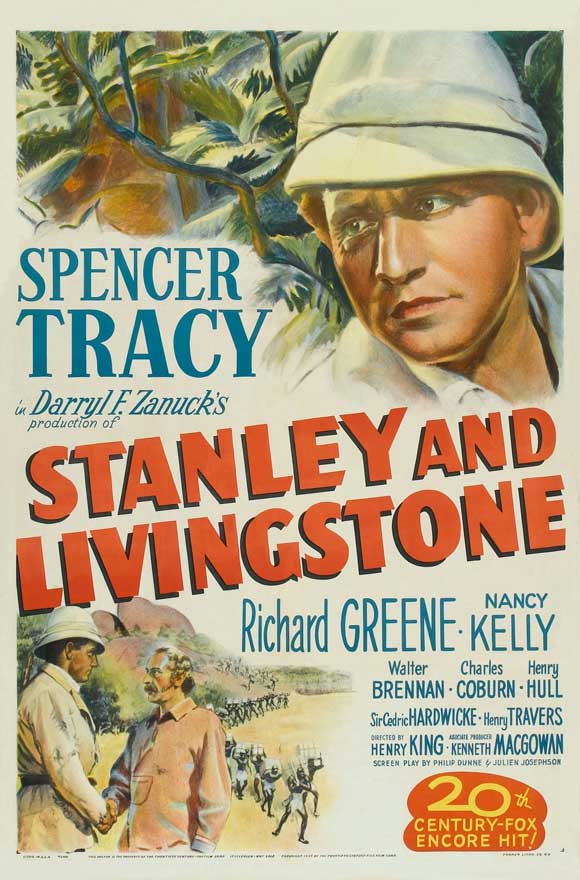
STANLEY AND LIVINGSTONE (1939)

In any other year, this well-made, if highly fictionalized bio-pic would be better known/more celebrated. But 1939 Hollywood was a tough year to stand out in.* So many good-to-great films to compete against. And now, changing views on the effects of Christian missionaries in ‘the Dark Continent’ (here, mid-19th Century notions refracted thru mid-20th Century) lend uncomfortable undercurrents to what was meant as triumphant storyline. Not so much on the good doctor, Livingstone quite the remarkable self-made man, explorer/geographer as much as religious proselytizer, but with newsman/exploiter Stanley whose hunt for the doctor in uncharted African territory shapes the narrative and sidesteps problematic areas. His token opposition to the slave trade mere cover. All-in-all a tough modern sell even if you don’t know much of the real man. That said, on its own terms this is quite impressive filmmaking; with second-unit African footage unusually well-integrated on process soundstages for L.A. stay-at-homes Spencer Tracy & Cedric Hardwicke. Scripter Philip Dunne finds workable story beats for Tracy in thwarted romance, tribal war, tropical diseases, and a big Science Academy showdown finale. (Very Warner Bros. bio-pic that.) All kept on the move by director Henry King who even had a Chief White Hunter credited as part of his African second-unit!

DOUBLE-BILL: *It was a crowded field in 1939. Hardwicke’s other two films just that year were ON BORROWED TIME (from Paul Osborn’s fine & clever play on the grim reaper) and William Dieterle’s stunning HUNCHBACK OF NOTRE DAME. (Note Hardwicke in demand at M-G-M, R.K.O. and 20th/Fox.)

ATTENTION MUST BE PAID: They say it took twenty takes before Tracy (returning to Fox five years after he’d been kicked out) could say ‘Dr. Livingstone, I presume,’ without cracking up.

Sunday, September 15, 2019

BULLITT (1968)

Hiding in plain sight behind the spectacular (and spectacularly real) car chase sequence everyone knows, is an exceptional police procedural that shouldn’t be taken for granted. Steve McQueen, in his absolute prime (nearly as cool as his Mustang GT.), is the tough, stubborn San Fran detective who lands in the soup when a hot witness under his protection takes a hit. Under pressure to clear up his mess over the weekend, the clues and obstacles follow fairly standard cop thriller tropes, but the execution from director Peter Yates, cinematographer William A. Fraker & editor Frank Keller update genre conventions by a generation, still looking fresh and inventive. Yates is particularly sharp throughout, loading an active frame with startling shards of info in subtle visual jolts, beautifully caught by Fraker on real locations in a style that’s closer to edgy European than overlit ‘60s Hollywood. (Compared to Don Siegel’s MADIGAN, a fine procedural from the same year that’s echt Universal Studios, BULLITT comes off as stylistically revelatory/revolutionary.*) Many scenes play with little or no dialogue, but there’s just enough for the outstanding supporting cast to make a mark. Not only Jacqueline Bisset and an amusingly smarmy Robert Vaughn (doing a Bobby Kennedy turn), but also standout early sightings of Robert Duvall & Georg Stanford Brown. More than the sum of its procedural parts, and more than its great car chase, BULLITT grabbed onto a new late ‘60s Zeitgeist.

ATTENTION MUST BE PAID: *So too an opening credit sequence laying out the initial crime in snazzy high cinematic fashion. Worth revisiting right after you’ve finished watching.

DOUBLE-BILL: Robert Altman’s odd/uneven/comic BREWSTER MCCLOUD/’70 used Michael Murphy and a drawer-full of turtlenecks to send up the BULLITT mystique.

Saturday, September 14, 2019

MISSION: IMPOSSIBLE - FALLOUT (2018)

After Brad Bird rebooted Tom Cruise’s fading MI series as a witty update of a Roger Moore-era James Bond thriller in GHOST PROTOCOL/’11, writer/director Christopher McQuarrie took over the series for more of the same in #5. Too much more of the same, upping the quotient of fun & games relentlessly into a joyless franchise with eyes on the foreign market.* Cruise and Paramount must have been happy though, since he’s back for #6 (7 & 8, too!) with the longest MI yet. (By nearly half an hour!) The usual Spy vs Spy nonsense (with silly rubberized faces) brings international intrigue & arbitrary crosses, double-crosses and ‘surprise’ turnabouts as our gang of ‘Impossibles’ pursue three missing orbs of plutonium timed to go off in Kashmir and wreck half the world’s water supply. The action scenes are fast, furious and exhausting; also impossible to figure out/read, which should be half of the fun. Instead, Tom relies on his energizer bunny routine, clenching his jaw to hide any recent face work. Talk about mission impossible!

SCREWY THOUGHT OF THE DAY: I know it’s part of his job description as Group Techie, but must Ving Rhames be the only guy shown carrying bags in the pic as if he were the MI porter? Sheesh.

ATTENTION MUST BE PAID: *Stateside grosses barely (or simply not) keeping pace with ever growing budgets.

Friday, September 13, 2019

THE BIG HOUSE (1930)

Exceptional. A rare Early Talkie that thrives, rather than withers, under the technical limitations of the silent-to-sound transition period, with difficulties in film production turned into dramatic assets. The lack of slickness and weight of each camera movement aiding verisimilitude as much as the strikingly designed sets. Writer Frances Marion covers (or is it invents?) just about every prison pic trope out there, with then-husband George W. Hill’s unflinching direction missing nothing, as young, terrified Robert Montgomery gets ushered into the massive jail for a ten-year stint that will test his character along with cell mates Wallace Berry (brutal, explosive) and Chester Morris (tough but decent). Marion throws us off-balance right after the opening reel, switching her main protagonist from an apparently sympathetic Montgomery to Morris’s seen-it-all wiseguy. All three leads at their best: Montgomery, playing without his usual polish & proving despicably weak (superbly lit to expose character by Hill’s regular lenser Harold Wenstrom); Berry testing limits in bulky threat, yet oddly likeable; Morris in such heroic form, you wonder why he ever slipped into B-pics. It’s a huge production, hundreds of prisoners, a dozen strong character roles, and a remarkably uncompromising action finale that still astounds. Powerhouse stuff.

DOUBLE-BILL: Hill & Marion continued this vein in ‘31 with Berry in THE SECRET 6, finding a new star in sixth-billed Clark Gable whose part seems to grow as the film goes along. OR: Howard Hawks’ nearly contemporary, if not nearly as good, prison pic, THE CRIMINAL CODE/’30.

ATTENTION MUST BE PAID: Note our second poster for what must have been the Spanish version, made before subtitles or dubbing came into common use, probably shot at night on the same sets, but with different leads in the main roles.

Thursday, September 12, 2019

THE DAREDEVIL DRIVERS (1938)

No one’s much fun to be with in this Warners programmer about a banned racecar driver who sues a bus company for damages when one their coaches wrecks his speedster. But he just might change his mind after meeting the company owner, a pretty gal in danger of being run out of the biz thru sabotage from within and a power play from without by a larger competitor. Sounds like a workable plot, and with second-unit action director B. Reeves Eason calling the shots over a one-hour running time it should make some sort of mark. But the minor league players in the cast are anything but good company (alpha male Dick Purcell, a poor man’s James Cagney, especially weak*), and there’s not enough racing footage to make up for what’s missing. (All stock shots, newsreel accident footage & backscreen process work.) A pity, because hiding in plain sight is a perfectly hilarious story idea Purcell proposes to get back on his feet: use underemployed race car drivers on all the bus routes for extra-speedy service runs! A spectacularly silly idea! Imagine terrified customers & uninsured accidents as motorbike cops chase revved-up buses on those curvy two-lane country highways. Kids on the bus in thrall to all the excitement & danger; oldsters losing their lunch as the bus all but tips over on hairpin turns. You get a taste of this when company owner Beverly Roberts drives a bus with failing brakes, but it’s a suspense sequence not comedy. Too bad.

ATTENTION MUST BE PAID: Spot some company siblings in debuting Gloria Blondell (kid sister of Joan) and Charley Foy (kid brother of King of the ‘Bs’ producer Bryan Foy) doing comic relief. He’s okay; she overplays something awful.

WATCH THIS, NOT THAT: * The real James Cagney hits the race track (and Joan Blondell) in Howard Hawks’ THE CROWD ROARS/’32.

Wednesday, September 11, 2019

DOCTOR ZHIVAGO (1965)

In spite of awards & commercial success, epic filmmaker David Lean was always quick to point out that ‘DOCTOR ZHIVAGO got the most terrible reviews worldwide,’ but that ‘it made more money than all my other films put together.’ The initial critical reception is surprising. Perhaps the film seemed old-fashioned in a bad way in ‘65, too plush, too well-groomed, even for an advance-ticket RoadShow item about social change & romance amid the Russian Revolution & follow-up Civil War. The film’s still old-fashioned, but now in a mostly good way, with solid, literate story construction (check out the parallel editing of story lines in the first act), handsome, if studied, compositions (if rarely breaking the bounds of tableau vivant), and a roll-call of vivid character actors who know just how to scale up to Lean’s epic-sized vision (naturalism be damned). Note Alec Guinness’s glacial cadences turning a nothing part as Zhivago’s politically connected older half-brother into showy star turn. As the largely passive, too-good-to-be-true doctor, Omar Sharif doesn’t get the credit he deserves, holding the film and his indecisive love life together with little more than moist puppy dog eyes, the indispensable leading man. Grander turns come from Tom Courtenay’s neurotic radical; Rod Steiger’s brutal lover/power player (the only multi-faceted & believably Russian character in here); and Julie Christie, thrillingly beautiful, tempest-tossed love of all three men; object of Zhivago’s most famous poems, wisely left unheard in Robert Bolt’s clipped, clever screenplay. At its best pre-intermission, the plot turns sloppy & repetitive in the last hour. But Lean paces so well, keeping up grand vistas & violent set pieces with thousands between intimacies, you never lose interest. Even when Maurice Jarre’s score gets stuck in auto-repeat mode.

DOUBLE-BILL: Julie Christie had another literary pick of three men (Alan Bates, Terence Stamp, Peter Finch) in John Schlesinger’s undervalued FAR FROM THE MADDING CROWD/’67. Superbly shot by Nicolas Roeg who actually started ZHIVAGO only to be replaced after a couple of weeks by Lean fave Freddie Young.

ATTENTION MUST BE PAID: Keep a sharp eye for visual nods at classic Soviet cinema, mostly Sergei Eisenstein (POTEMKIN; NEVSKY) and Aleksandr Dovzhenko (EARTH).

Tuesday, September 10, 2019

THE BLUE DAHLIA (1946)

The only original screenplay from L.A. crime novelist Raymond Chandler came out of an unfinished novel he was stuck on. Coaxed by producer John Houseman, with Paramount in a rush for an Alan Ladd feature before he resumed military service, it had to come together fast. But Chandler’s writer’s block returned before the third act, and he only managed to get it done by working from home with the aid of copyists, studio couriers and constant, heavy boozing.* With a Hollywood backstory this good, you wish the film were its equal. It’s not, much heavy lifting needed to get this story up on its feet. But once war vet Alan Ladd’s unfaithful wife is killed and he goes on the lam after a meet-cute/pick-up with Veronica Lake (she picks him up!), and the cops start investigating a host of tasty suspects, the film grows too entertaining to nitpick. George Marshall’s direction treads along at a somber, unvarying pace, but that atmospheric title seems to cast a lucky spell on all the implausible doings. William Bendix, as Ladd’s army bud with a metal plate in his head & explosive tendencies has a field day as a murder suspect so obvious you just know he couldn’t have done it. (Apparently, Chandler wanted him for it, but ran into objections from the real U.S. Army.)

READ ALL ABOUT IT: *The hair-raising behind-the-scenes story of the production, with Chandler risking the bottle in order to finish on time, is neatly covered in FRONT & CENTER, second in John Houseman’s three-part auto-bio.