Now over 6000 Reviews and (near) Daily Updates!

WELCOME! Use the search engines on this site (or your own off-site engine of choice) to gain easy access to the complete MAKSQUIBS Archive; over 6000 posts and counting. (New posts added every day or so.)

You can check on all our titles by typing the Title, Director, Actor or 'Keyword' you're looking for in the Search Engine of your choice (include the phrase MAKSQUIBS) or just use the BLOGSPOT.com Search Box at the top left corner of the page.

Feel free to place comments directly on any of the film posts and to test your film knowledge with the CONTESTS scattered here & there. (Hey! No Googling allowed. They're pretty easy.)

Send E-mails to MAKSQUIBS@yahoo.com . (Let us know if the TRANSLATE WIDGET works!) Or use the Profile Page or Comments link for contact.

Thanks for stopping by.

Tuesday, May 10, 2022

ORIGINAL CAST ALBUM: COMPANY (1970)

Just what the title says, a 15 & a half hour studio session (plus pick-up vocal a few days on) as Stephen Sondheim’s career defining musical is recorded for vinyl shortly after opening to raves on B’way.  Condensed to an hour for primetime NBC tv by docu-filmmaker D.A. Pennebaker, it’d never make it to network broadcast today.  One of Sondheim’s most revived/least reviled shows (currently on B’way with a gender switch: leading man Bobby flipped to leading woman Bobbie), the problematic book (a series of facile sketches meant to convince Bobby that marital plunge is worth  the horror show of couples he sees in his best friends) happily avoided in this behind-the-scenes look at Sondheim’s phenomenal score & lyrics.  Blood, sweat, tears & make-up-free skin pores from the amazing talent in front of the mikes and back in the booth.  Plus, you don’t have to be a B’way nerd to get into it.  But those who are will be shocked at all those singers puffing away; at how much better soon-to-depart leading man Dean Jones (yes, of the Disney films) sounds on Pennebaker’s sound mix than he does on the finished album*; at the phenomenal voice from little-known Pamela Myers singing ‘Another Hundred People’ (very Linda Ronstadt); spotting pre-MURPHY BROWN Charles Kimbrough; or just reveling in a lost B’way era.  If only Pennebaker would give us a longer cut, one that needn’t fit into a one-hour time slot.

DOUBLE-BILL: It’s an AUDIO Double-Bill.  Stream the original cast album to hear the two-thirds that goes missing here.  Including Elaine Stritch blasting out the longest, loudest, flattest note in B’way album history at the end of the opening number.  How’d that get by amazingly patient, amazingly calm album producer Thomas Z. Shepard?

ATTENTION MUST BE PAID: *Jones left the show soon after the opening (personal issues; he and his wife headed for divorce) with Larry Kert, B’way’s original WEST SIDE STORY Tony, taking over before being followed in turn by yet another WSS alum, George Chakiris, the film’s Bernardo.

Monday, May 9, 2022

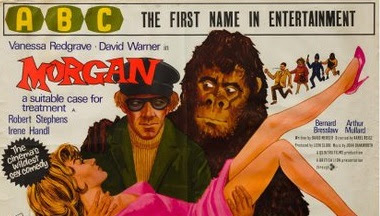
MORGAN: A SUITABLE CASE FOR TREATMENT (1966)

Successfully marketed as a ‘Mod’ British New Wave sex comedy (see poster), a ‘60s Youth Culture film, like THE KNACK/’65 or GEORGY GIRL/’66, a must-watch to keep up at your next cocktail party, Karel Reisz’s film filters David Mercer’s politically facile script thru up-to-date Carnaby St. era stylistics.  It makes a fascinating time-capsule, but a very lumpy trip.  Star-making for David Warner & Vanessa Redgrave, commandingly glamorous as the uncoupling twosome.  HER: rich old-money, just divorced from Morgan, getting set to marry her ex’s agent, Robert Stephens.  HIM: artistically blocked painter, raised proletarian Communist and breaking apart with the stress of having a foot in both camps.  In an odd choice that likely ‘made’ the film, Mercer expresses Warner’s  metastasizing mania thru a gorilla fixation: real docu-footage (in the jungle/at the zoo); KING KONG and TARZAN film clips; and most memorably with a gorilla suit donned by both Redgrave and Warner.  Often wildly inventive (even structurally, skipping a first act), it’s really quite a sad film, with a downward trajectory that audiences somehow didn’t take out of the theater.  Our poster really is how people talked about this.

DOUBLE-BILL/LINK:  As mentioned, THE KNACK and (first choice) GEORGY GIRL with Vanessa’s sister Lynn, both Redgraves Oscar nom’d this year.  https://maksquibs.blogspot.com/2015/08/the-knack-and-how-to-get-it-1965.html  https://maksquibs.blogspot.com/2019/10/georgy-girl-1966.html

CONTEST:  Redgrave & Reisz reteamed on ISADORA/’68 which is prefigured here.  Name the scene mirrored to win a MAKSQUIBS Write-Up of your (streamable) choice.

Sunday, May 8, 2022

THE BRINK'S JOB (1978)

The fourth version of this big deal 1950 robbery of the Brink’s Boston counting house, $25 mill taken by a third-rate gang of mugs, is too cute for words.  Director William Friedkin, just off SORCERER/'77, a disastrously received masterwork, no doubt leapt at the chance to step in when producer Dino de Laurentiis canned John Frankenheimer.  The idea was to give Universal Pictures the colorful, splashy followup to hit period caper THE STING/’73 they’d been trying to reproduce in a series of misfires.  It helps explain the bright gloss & shiny artifice in spite of being made in & around Boston, Mass. and not at Universal Studios, Culver City.  Maybe it would have worked better without the attempt at verisimilitude.  As it stands, Peter Falk & his colorful streetwise cohorts all seem to be constantly winking at each other (or us) as they work a ridiculously easy cash takeaway from the wizened Katzenjammer Kids charged with locking up all that protected loot.  Money launderer Peter Boyle (the one-eyed man in a gang of the blind) & wild card ‘expert’ Warren Oates manage to freshen up their moldy characters, while Sheldon Leonard, who once played wiseguys before becoming a top tv sit-com producer, is amusingly cast as J. Edgar Hoover.  Everyone else, including Friedkin, just take de Laurentiis money and run.

DOUBLE-BILL/LINK: For some reason, this reminded me of the lightweight vehicles Universal was making in the mid-‘50s for a young Tony Curtis.  Sure enough, it was one of those vehicles: SIX BRIDGES TO CROSS/’55 (not seen here).  OR: Friedkin in excelsis with SORCERER.  https://maksquibs.blogspot.com/2018/12/sorcerer-1977.html

Saturday, May 7, 2022

THE WEB (1947)

After early ‘40s programmers & war service, director Michael Gordon returned to Hollywood for this neatly turned film noir.  Working on a very short leash at Universal, Gordon seems emboldened rather than curtailed by the tight budget, standing sets and B-list cast.  Make that B+ cast with Edmund O’Brien (still reasonably trim & sweat-free) as a striving lawyer just dumb enough to think he’s getting a career break from rich industrialist Vincent Price.  He’s really being set up in a scheme to knock off Price’s old partner just out of jail after taking the rap on a million dollar swindle.  (A clean-shaven Price always a giveaway to his being the bad guy.)  As Price’s personal secretary, Ella Raines has a rare good role playing the gal-in-the-middle (falling for O’Brien/loyal to her generous boss) while William Bendix steals all his scenes as the detective who’s O’Brien’s pal and the investigating officer on the case.  Part & perf a variation on Edward G. Robinson in DOUBLE INDEMNITY with Bendix none the worse for the comparison.  The film can’t quite overcome a certain over-familiarity, even at the time the twists couldn’t have surprised many, but its foreshortened perspective look and snappy pace, along with the moody Hans Salter score and a few unexpected edits (look fast for an unprecedented smash cut after a shooting) make the film a fun watch.

DOUBLE-BILL/LINK:  As mentioned, DOUBLE INDEMNITY/’44.  OR:  Another Raines noir we’ve pushed your way before, IMPACT/’49.   https://maksquibs.blogspot.com/2019/01/impact-1949.html

Friday, May 6, 2022

THAT OBSCURE OBJECT OF DESIRE / CET OBSCUR OBJET DU DÉSIR (1977)

Luis Buñuel hit upon a distinctive new tone on his last three films; serenity of age buffering the old savageries.  Politics, religion & upper-middle-class mores still targeted, but now playing with the knowledge that the fight’s been won even before the lights go down.  If not in the world at large, than in the cinematic universe, adding an undertone of delight.  First & best of the three was DISCREET CHARM OF THE BOURGEOISIE/’72, with PHANTOM OF LIBERTY/’74 less followup than vaudeville.  OBJET, something of a return to form.  Like DISCREET, it’s about not getting what you want.  There dinner; here sex.  And the closer you get, the surer your goal will prove unreachable.  Surprisingly, modern day terrorism a leading figure in both.  And if nothing here can match DISCREET's dinner guests hiding under a table from machine gun fire while hopefully reaching above for those untouched plates of food, there’s still plenty of food for thought (and hilarity) as wealthy, middle-aged Fernando Rey relates his amorous tale of woe to fellow train travelers all about young, beautiful, coitus-withholding Conchita, alternately played by warm/earthy Ángela Molina & elegant/angular Carole Bouquet.*   Filmmaking never looked so easy, but don’t be fooled.  At 77, it took a lifetime to get here.

ATTENTION MUST BE PAID:  *Buñuel pulled the plug on his first attempt when Maria Schneider proved impossible to work with, coming back to the project after he & collaborator Jean-Claude Carrière thought to split the role between two actresses.

DOUBLE-BILL/LINK:  Pierre Louÿs’ novel filmed many times, including THE DEVIL IS A WOMAN/’35 (Marlene Dietrich/Josef von Sternberg).  But the basic idea of unconsummated frustration closer to Ernst Lubitsch’s equally frustrating misfire BLUEBEARD’S EIGHTH WIFE/’38.  https://maksquibs.blogspot.com/2012/02/bluebeards-eight-wife-1938.html

Thursday, May 5, 2022

CHISUM (1970)

Even John Wayne couldn’t avoid the customary post-Oscar® slump after TRUE GRIT/’69 brought the little man his way.  Eleven films to go before he was thru, all disappointing (or worse) other than THE COWBOYS.*  Wayne, hoping to buck tradition, tried with Howard Hawks, John Sturges & Don Siegel, but all three directors seriously off-form.  While here, in the fourth of five films with the reprehensibly coarse Andrew L. McLaglen, he’s not even trying.  A big production, too: handsome locations, lots of horse & cattle flesh, a bevy of second-tier ‘names’ in support.  But in dialogue, acting, bald-faced exposition, dramatic construction, use of ‘with-it’ fast zoom shots as exclamation points, indigestible title song repeating like a bad radish, two Bob Mitchum sons, risibly mean villains and a stunt double for the ages for our aging lead, this tussle over land & cattle may be the worst of Wayne’s later vehicles.  And to appease the youth market, Billy the Kid's on hand.  Alas, with the ‘wrong’ Deuel brother hired to play him; pixie-ish Geoffrey instead of talented, tragic brother Peter.

ATTENTION MUST BE PAID: Pamela McMyler, shockingly bad as Wayne’s niece/Billy-the-Kid’s g’friend, got her start in AMBLIN’/’68, the short film that landed a 22-yr-old Steven Spielberg an agent.  No dialogue on that near silent, so maybe she’s a little better. 

WATCH THIS, NOT THAT/LINK: *Normally Mark Rydell can give McLaglen a run for his money in lousy direction (see ON GOLDEN POND/’81).  But he's on his best behavior for THE COWBOYS/'72. https://maksquibs.blogspot.com/2019/10/the-cowboys-1972.html

Tuesday, May 3, 2022

NIHON NO ICHIBAN NAGAI HI / JAPAN'S LONGEST DAY (1967)

Corporate-style filmmaking to celebrate a corporate anniversary (35 Years of TOHO Film), this WWII endgame story makes a fascinating watch.  (As for accuracy, don’t look here!)  Directed by Kihachi Okamoto, a late draftee in the war*, it handles a myriad of military & government characters (much narration/much on-screen identification) thru intense cabinet meetings over a single day working out the exact terms of surrender & the precise wording of the Emperor’s announcement, recorded for air-play the next day.  In theory, in spite of sidebar scenes of military action, this might be as tedious for an audience as it must have been for the exhausted ministers & top-rank officers.  Both shown reluctantly tipping toward an admission of defeat only after Hiroshima and Nagasaki were bombed.  But at the halfway point, the film takes a decisive turn and changes focus to what had been minor background rumbling from military units fundamentally (make that fanatically) opposed to any terms of surrender and determined to fight on.  Quickly organizing a brutal multi-stage rebellion against their superior officers, insubordination in the name of ‘patriotism,’ their actions include violently taking over the Emperor’s compound.  Top priority: finding that recorded speech.  ‘My Kingdom For A Horse’ updated to ‘Our Kingdom For a 78rpm Laquer Disc.’  (A detail this bizarre has got to be historically accurate.)  Many well known faces involved, including Yasujirô Ozu’s usual father figure Chishû Ryû and Toshirô Mifune shortly after his last film with Akira Kurosawa.  Not great filmmaking by any means, but cumulatively effective.

SCREWY THOUGHT OF THE DAY: *The film leaves you with the impression that Okamoto believed the atomic bombs were the only way to end the war quickly.  And approved of their use?  The time factor likely saving his life as a late conscriptee.  Not an idea you expect in a Japanese film of the period.

Monday, May 2, 2022

NUMBER 17 (1932)

Flummoxing Alfred Hitchcock completists for decades, this comic thrilller wouldn’t have felt particularly unfamiliar to audiences of the day after popular fare like THE OLD DARK HOUSE/’32, THE CAT AND THE CANARY/’27 or THE BAT WHISPERS/’30.  But would have looked just as bad.  Hitch’s comments (in toto) per his seminal interview book HITCHCOCK/TRUFFAUT:  ‘A disaster.’  And yet Hitchcockians need to see it, but will have to sit tight thru the first five reels, stuck in a ‘vacant’ house infested with ‘not’ dead bodies; jewel thieves; undercover cops; a deeply unfunny ‘comic cockney’; ladies with a penchant for furs & handcuffs; and a putative renter with a nose for trouble who bumps into a scam no one could possibly make head or tails of.  Under the gaze of a surprisingly mobile camera & pointless visual trick shots hoping to liven things up, business plays out at a glacial pace except for a pair of amusingly undercranked fight scenes.  (Did the sound engineer order the cast from picking up their cues?)  At last we clear out for the final reel & a half, a dilly of a chase sequence via train and bus.  A fabulist’s conception of speed & movement with more cul-de-sacs than a 10-episode serial, setting up a crash of a climax with everything changing over to delightful miniatures, a demented out-of-control toy train set (the deluxe model with the bus); anticipating Orson Welles’ famous quote upon first entering R.K.O. Studios: ‘This is the biggest electric train set any boy ever had.’

DOUBLE-BILL/LINK: Finally available in pristine condition, marginally helping the drama inside the house before the film comes to life with those glistening trains, both real & toy.   Uptick in watchablility comparable to the improvement thru a proper restoration in Paul Leni's THE CAT AND THE CANARY, mentioned above.    https://maksquibs.blogspot.com/2012/01/cat-and-canary-1927.html

Sunday, May 1, 2022

THE BLACK CAT / GATTO NERO (1981)

Italian Giallo/Horror specialist Lucio Fulci tackles Edgar Allan Poe (really just the title) in this modest gross-out thriller from his late international period.  Here, with British locations and Italian interiors, Patrick Magee stars as our cranky psychic (vocal cadences courtesy of Boris Karloff) who’s either controlling our eponymous pussy (or is it pussies?) or is controlled by them in a series of murderous assaults.  Fulci’s action chops pretty weak here, cat attacks mostly feline free-throws for minimal shock effect, and deadly paws more like paint brushes slathering on stage blood.  Things turn dire as various characters start catching on to his act and the police investigate, but too late to save a randy fellow hoist on his own petard when his air-conditioned den of inequity is sabotaged to become a sweat-box of death for him and his unwilling nubile victim.  All very 'meh.'  What does hold your attention is an unusual score from Pino Donaggio along with dazzling production design from Franco Calabrese.  Some scaffold-like staircases the most Poe-worthy element in here.

DOUBLE-BILL: Lucio Fulci has an expanding cult following, but we’ve yet to be convinced.  Perhaps some Fulci fan has a suggestion.   Click where it says 'Post a Comment' directly below.