Now over 6000 Reviews and (near) Daily Updates!

WELCOME! Use the search engines on this site (or your own off-site engine of choice) to gain easy access to the complete MAKSQUIBS Archive; over 6000 posts and counting. (New posts added every day or so.)

You can check on all our titles by typing the Title, Director, Actor or 'Keyword' you're looking for in the Search Engine of your choice (include the phrase MAKSQUIBS) or just use the BLOGSPOT.com Search Box at the top left corner of the page.

Feel free to place comments directly on any of the film posts and to test your film knowledge with the CONTESTS scattered here & there. (Hey! No Googling allowed. They're pretty easy.)

Send E-mails to MAKSQUIBS@yahoo.com . (Let us know if the TRANSLATE WIDGET works!) Or use the Profile Page or Comments link for contact.

Thanks for stopping by.

Monday, December 29, 2008

WHERE ARE MY CHILDREN (1916)

Although Lois Weber, the most important & successful of the early female helmers, tied many of her pics to social issues, surely none was as daring as this bifurcated look at birth control & eugenics in American society. Here, a world of drunken lower-class wastrels populate the tenements with unwanted brats while upper-crust ladies are so concerned with club life & high society that they routinely have abortions. Even using a disreputable doctor known for slip-ups. The two sides of this story merge when D.A. Tyrone Power, Sr brings an outspoken eugenics supporter to court just as he discovers his own wife’s immersion in the shadow world of illegal abortions. Much of the Social Darwinism approvingly shown here is faintly terrifying and Weber’s picturization of congregations of unborn souls may give pause*, but the general arguments remain timely & fascinating, to say nothing of her remarkably advanced narrative technique and the naturalistic acting. The film remains highly watchable and truly thought provoking.

SCREWY THOUGHT OF THE DAY: *Did Hugo Hoffmannsthal see this before writing the libretto of DIE FRAU OHNE SCHATTEN for R. Strauss in 1919?  Or did they both grab the basic idea from Maurice Maeterlinck’s THE BLUE BIRD?

Monday, December 22, 2008

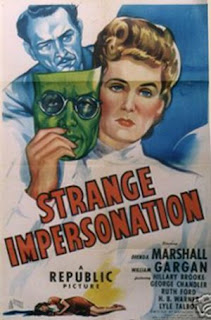
STRANGE IMPERSONATION (1946)


Ultra low-budget noir from Republic Studios has a ludicrous storyline, but is moderate fun thanks to an evenly matched cast of mid-level names (Brenda Marshall, William Gargan, Lyle Talbot, H. B. Warner) and more than a modicum of style from rising helmer Anthony Mann, who frames & chiaroscuros to beat the band. Marshall plays a research scientist more interested in her new anaesthetic than in fiancé Gargan. (Smart girl!) But when she's out cold, testing her new serum on herself, her spunky assistant (Ruth Ford) reveals her true colors by ruining her boss's looks and usurping her life. Fortunately, a transparent sub-plot allows the scripters to rig a swapped identity revenge twist . . . and that goes wrong, too! LEAVE HER TO HEAVEN/'45 is the obvious ‘inspiration’ here, but there's only so much Mann can do with this material which also features a lame cop-out ending. Try 1949's delirious IMPACT to see how this formula can be plotted to far better effect even without Mann’s stylish moves behind the camera.

Wednesday, December 17, 2008

GOOD NEWS (1947)

M-G-M musical producer supreme Arthur Freed baptized those ON THE TOWN New York wiseguys, Betty Comden & Adolph Green, with an unlikely assignment; revamp this corny mother-of-all college musicals. The 1927 show is only remembered for two songs, ‘The Best Things in Life Are Free’ & ‘The Varsity Drag,’ plus the usual football game theatrics, but the new script puts all irony on hold allowing us to smile with (rather than at) the well-calibrated conventions of musical comedy from ‘27 & ‘47.  (Alas, the 1930 Early Talkie of the show is a real varsity drag.)  Charles Walters helms smoothly in his debut, keeping everything human-scaled (with a nice expansion for the big finale), while the modest talents and challenged intonation of leads June Allyson & especially the young Peter Lawford seem just right in this low-pressure entertainment. Even if this sort of thing isn’t your sort of thing, search out ‘The French Lesson,’ the one original number Comden & Green added with Roger Edens supplying the music, it’s a true delight.

Wednesday, December 10, 2008

A MIDSUMMER NIGHT’S DREAM (1935)


Shakespeare in Hollywood took a near-fatal double hit when this big-budget pic from Warners along with M-G-M’s ROMEO & JULIET/’36 (a vanity project for Irving Thalberg & Norma Shearer) tanked. The latter is a stiff, but this adaptation of Max Reinhardt's legendary Hollywood Bowl production is not only visually luscious (thanks to Hal Mohr's ravishing lensing), but often charming & funny. Casting from the Warners stock company generally works out and is a lot of fun just to see. (No doubt The Globe used similar ‘types’ over & over again.) A few unsure line readings from some players can’t mar Joe E. Brown's inspired clowning, Victor Jory's billowing nightride or Olivia de Havilland's enchanting romantic fancy. Mickey Rooney hasn’t the technical variety to pull off Reinhardt’s wild-child conception of Puck, but he certainly looks amazing. And if some of the big set pieces hang fire, the adaptation is smartly done (though a lot of poetry gets the ax), easy to follow (thanks to some fine narrative tips in the editing) and quite respectful. Plus, using all that Mendelssohn on the soundtrack was a clever bit of nose-thumbing at the Nazis who had just banned his music in Austria & Germany.

Wednesday, November 26, 2008

YOU ONLY LIVE ONCE (1937)

Fritz Lang’s second Hollywood film is paradoxically more 'Langian' and more idiomatically American than his initial Stateside pic, FURY/’36 .  Henry Fonda & Sylvia Sidney are exceptional & heartbreaking as a doomed ex-con & the Public Defender’s asst who stubbornly believes in him as fate inexorably grinds away.  Classics like THEY LIVE BY NIGHT/’49, BONNIE & CLYDE/’67, THIEVES LIKE US/’74 and scores of lesser ‘Wanted’-lovers on-the-run pics are unimaginable without this film that in many ways (certainly in its devious fatalistic plotting & in capturing the spirit of Depression era times) holds up better than the later films.  (If only the original film materials were in better shape, alas!)  Watch for a bank robbery sequence that could have come straight out of a Fritz Lang MABUSE pic, and for his distinctively formal composition style (Leon Shamroy lensed) which only reemerged this consistently for Lang in SCARLET STREET/’45, WOMAN IN THE WIDOW/’44 and THE BIG HEAT/’53.

Monday, November 24, 2008

BUCCANEER’S GIRL (1950)


Unexpected fun. Hiding in a set of mediocre early 1950s pirate DVDs from Universal is this winning bit of nonsense starring that fetching non-actress Yvonne De Carlo as a stowaway who lands in the middle of a New Orleans trade war. The little remembered Philip Friend, with a tad of the old Ronald Colman charm, pulls off his faux pirate character (he’s really out to avenge a wronged father) while Elsa Lancaster, Henry Daniell & especially an alarmingly coiffed Norman Lloyd make up a tasty supporting trio. With better than routine megging from Frederick de Cordova, spirited musical interludes for Yvonne, neat miniature F/X on the seafaring battles and a pleasingly preposterous switchback/turnaround plot, producer Robert Arthur deserves kudos for not treating this as a routine programmer but as an opportunity to show off a bit.

Monday, November 17, 2008

AGAINST ALL FLAGS (1952)

Late swashbuckler for Errol Flynn has an undeservedly good rep. Megger George Marshall turned out a boilerplate pirate adventure w/ poorly integrated painted matte backgrounds canceling out a better than usual cast for Universal. (Maureen O’Hara, Anthony Quinn, Mildred Natwick, even character vet Robert Warwick shows up for auld lang syne, though nothing quite makes up for the appalling Alice Kelley as an Indian Princess). But the story is old as the hills (Flynn poses as a pirate to take down a safe haven for buccaneers); the dialogue flat (Flynn’s comic retorts are sad precursors for Roger Moore’s 007 asides); and the plot poorly structured (none of the incidents seem to add up to any sort of plan of action). Plus, Flynn looks fairly exhausted, out of breath and is poorly doubled in much of the action footage. (He still managed to break a leg.) Next year’s follow-up, THE MASTER OF BALLANTRAE, which brought him briefly back to Warners, allows Flynn a far more graceful adieu to the world of derring-do.

YANKEE BUCCANEER (1952)

Ho-hum pirate fare from Universal was rushed into production on the sets of AGAINST ALL FLAGS when Errol Flynn broke his leg. It has a perfectly acceptable set-up (young David Farragut boards his new ship carrying orders for it to go undercover as a pirate ship and expose a seafaring conspiracy), but there’s not much fun in the pinch-penny production, static staging or dull cast. Jeff Chandler & Scott Brady hardly light up the sky with charisma, but they’re veritable Oliviers next to dud leading lady, Suzan Ball. The ‘z’ is for zzzzzzz. Frederick de Cordova, who did the routine megging, became the longtime producer for Johnny Carson’s TONIGHT SHOW. And if you’ve ever wondered who okayed Carson’s astonishingly unattractive sets, have a look here. Those pirate outfits!

Thursday, November 13, 2008

LIAM (2000)

Stephen Frears, the most unassuming of master directors, brings intelligence & technical fluidity to this overly-familiar family drama set in a fading British industrial town during the depth of the ‘30s depression and the rise of radical political ‘isms.’ Told largely, but not exclusively, through the eyes of the entirely winning seven yr-old son who’s afflicted with a terrible stutter, the story first hits the expected warm & fuzzy notes (booze, sex, tough-love parents, the absurdity of a strict Catholic schooling), before turning remarkably dark and compelling when Dad (Ian Hart) loses his job, his pride and his bearings. In a lacerating perf, Hart disappears inside rantings and xenophobic violence as the quicksand of historical movements unhinge his better nature. But neither he nor Frears can do anything with the disastrous twist ending which all too conveniently turns to cheap & tidy theatrical tricks to round things up. It sours the entire film.