Now over 6000 Reviews and (near) Daily Updates!

WELCOME! Use the search engines on this site (or your own off-site engine of choice) to gain easy access to the complete MAKSQUIBS Archive; over 6000 posts and counting. (New posts added every day or so.)

You can check on all our titles by typing the Title, Director, Actor or 'Keyword' you're looking for in the Search Engine of your choice (include the phrase MAKSQUIBS) or just use the BLOGSPOT.com Search Box at the top left corner of the page.

Feel free to place comments directly on any of the film posts and to test your film knowledge with the CONTESTS scattered here & there. (Hey! No Googling allowed. They're pretty easy.)

Send E-mails to MAKSQUIBS@yahoo.com . (Let us know if the TRANSLATE WIDGET works!) Or use the Profile Page or Comments link for contact.

Thanks for stopping by.

Friday, January 31, 2014

TUNES OF GLORY (1960)

Half the cast could be auditioning to play Captain Queeg in this fascinating, if only partially successful, peacetime military drama set in a Scottish Regiment facility. Alec Guinness, in galumphing form as acting head (it’s more of a Trevor Howard role), finds he can’t stomach his replacement, John Mills’ by-the-book commander (in the usual Guinness role). There’s a daughter and a wayward mistress for Guinness, plus various officer cliques, but the main action comes out of the mental mano-a-mano between Guinness & Mills, especially once Alec strikes a superior. In many ways the situation recalls one of John Ford’s Cavalry pics, like FORT APACHE/’48, but with the strengths & weaknesses of Henry Fonda’s martinet and John Wayne’s regular army guy ill sorted between these two. Get past the broad characterizations & verbiage of an opening act that plays like an untrimmed stage script, and the demands of rank & honor, along with seesawing personal sympathies will pull you in, letting the inevitable crack-ups make their dramatic mark.

SCREWY THOUGHT OF THE DAY: The DVD transfer on Criterion is a disappointment. Not only is there a nasty vertical blemish over much of the penultimate reel, but Arthur Ibbetson’s lensing shows inconsistent lighting levels, even within scenes. Ibbetson, the least gifted of the early British colour cinematographers (like Chris Challis, Jack Cardiff, Freddie Young, even this film’s director Ronald Neame), had a better outing on the previous Neame/Guinness film, THE HORSE’S MOUTH/’58.

DOUBLE-BILL: Guinness’s first film with Neame directing, THE PROMOTER/’52 (aka THE CARD), isn’t as well known as their later three films. But that Ealing Studios piece about a social climbing scamp (with delicious assists from Petulia Clark & Glynis Johns) is a total charmer.

Thursday, January 30, 2014

THE UNINVITED (1944)

A sober-sided Haunted House pic that takes its ghosts seriously, and to still scarifying effect. Unusually for the period, this Paramount chiller is luxly produced, a modern Gothic (more REBECCA/’40 than THE OLD, DARK HOUSE/’32), very light on spectral effects, with Ray Milland & Ruth Hussey’s brother & sister quickly accepting paranormal reality in order to delouse their new house of unwanted spirits. Milland is fighting because he’s fallen for local girl Gail Russell who was born there and now seems possessed by it; Hussey’s more along for the ride, though she does wind up with Alan Napier’s tall, sensible doctor. Creepier than any ghost is stage actress/monologist Cornelia Otis Skinner in a rare film appearance as Miss Holloway, a friend to Russell’s late mother and a blatant rip-off of REBECCA’s Mrs. Danvers. It makes a fine debut for helmer Lewis Allen though he owes much to art director Hans Dreier & to the candle-powered chiaroscuro of lenser Charles Lang.

SCREWY THOUGHT OF THE DAY: Out in a glittering DVD transfer from Criterion, the film offers a fine opportunity to appreciate the top-notch process work Paramount regularly turned out under the supervision of Farciot Edouart. It’s a name that sticks out in the credits and a man who, so they say, took many technical tricks with him to the grave.

Wednesday, January 29, 2014

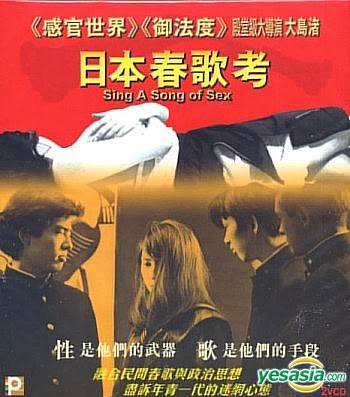
NIHON SHUNKA-KO / SING A SONG OF SEX (1967)

Best known for the sensationalist aspects of IN THE REALMS OF THE SENSES/’76 and MERRY CHRISTMAS, MR. LAWRENCE/’83 (not so much for the films themselves), this earlier work from Japanese writer/director Nagisa Ôshima finds his compositional skills far outpacing story, characterization & philosophy. The film tags along as four aimless high school grads wonder about test scores & their future, ogle co-eds and interrupt anti-Vietnam sing-alongs (of The Weavers Greatest Hits!) with a raunchy ditty their Prof taught them during a booze-fueled meal. As night turns to day, the disaffected youths are revealed as both amoral & apolitical, with a passive approach to life that brings fatal consequences. The smell of the ‘68 student riots is already in the air (along with Kubrick’s A CLOCKWORK ORANGE/’71), but the issues, as presented, feel forced, reprehensible actions as tricked-up as in some Neil LeBute ‘problem’ play. The real puzzle is why no one says ‘No’ to these neatly dressed punks. Just another mystery of Japanese culture that doesn’t translate or travel*, though it does leave you with an appetite for more Oshima.

SCREWY THOUGHT OF THE DAY: *Stateside viewers will spot the usual Western product advertisements in the backgrounds, including a great Coca-Cola logo. But look fast to catch Julie Andrews & Paul Newman on a TORN CURTAIN poster. How did that one ‘translate & travel?’

Tuesday, January 28, 2014

THE LAST WAGON (1956)

In the 1950s, Hollywood found it was able to deal covertly with post-war race issues and the burgeoning Civil Rights Movement thru the Western. Not only were displays of physical affection between Native Americans (usually female) and Whites (usually male) acceptable on screen, but with the Indian Nations divided into Tribes of widely differing customs & attitudes, story construction problems were incredibly easy to solve. American Indians could take on the role of courageous good guy, hapless victim and the mystical baddie, and all in the same pic! (Just be sure you get the arrow markings right.) Delmar Daves, one of those writer/directors who covered a lack of natural visual aptitude with handsome locations & tricky camera placements, should probably get credit for starting the racial substitution ball rolling with BROKEN ARROW/’50. But this lesser-known title is at least as good, with a commanding turn from undersung star, Richard Widmark, as a Comanche-raised white man wanted on a multiple murder charge. The story gimmick strands him with a gaggle of surviving teens from a small wagon train who’ll have to cross a desert and face converging Apaches to survive. And the kids are a fine collection of young actors (Susan Kohner, Felicia Farr, Nick Adams, and LASSIE’s own Tommy Rettig) all fun to watch. Things wrap up with a mess of unconvincing courtroom speechifying after a short-changed action finale, but the feel-good ending is worth the dodge.

DOUBLE-BILL: Daves’ best Western, 3:10 TO YUMA/’57, avoids the whole Native American race issue and goes for pure nail-biting suspense. Much better than the recent (2007) remake.

Monday, January 27, 2014

JUAREZ (1939)

The last of the three waxwork historicals Paul Muni made with helmer William Dieterle may well be the waxiest, but it's also of uncommon interest. After LOUIS PASTEUR/’36 and EMILE ZOLA/’37; the early Mexican Presidente looks like some ancient Aztec carving come halfway to life, but, in its deliberative manner, rather effective. And in John Huston’s conflicted script, political & personal sympathies land uncomfortably between the striving local rebels and the duped, but kindly Hapburgs (Brian Aherne; Bette Davis) who play out unexpected destinies. It’s one of those Hollywood pics that goes beyond its intellectual depth, unintentionally stumbling into nuance & ambiguity while clinging desperately to formulaic tropes; the tension can be riveting. A huge cast of top-flight Warners contract players are in support, including a few out-of-place ringers (Donald Crisp?, John Garfield?), but the familiar faces help to keep track of a highly eventful story that lost a couple of reels after an early preview. Anyway, who needs a scorecard when you’ve got an Erich Wolfgang Korngold score with all those yummy leitmotifs? These Muni/Dieterle Great Man bio-pics have been out of favor for decades, but as simplified, potted history (plus allegorical glances at WWII), they’ve aged into entertaining artifacts in their own right.

DOUBLE-BILL/LINK: Dieterle’s next bio-pic, DR/ EHRLICH’S MAGIC BULLET/’40 with Edward G. Robinson, was a far more modest production, but truly daring in subject matter for the period, the search for a cure to syphilis.  https://maksquibs.blogspot.com/2019/03/dr-ehrlichs-magic-bullet-1940.html

Saturday, January 25, 2014

INNOCENT BYSTANDERS (1972)

It’s sideburn heaven (or hell) in this James Bond wannabe that lands with a brutal thud, falling between the cracks of outright spoofery and serious intentions. Stanley Baker, looking & acting like an unkempt Welsh stand-in for Sean Connery, never gets a rhythm going under Peter Collinson’s painfully amateurish megging, and neither spy masters Dana Andrews & Donald Pleasence, gal pal Geraldine Chaplin or a motley assortment of bad guys bring anything fresh to the party. Nor does the McGuffin, something about a revolutionary desalination process. Talk about excitement! Whatever interest there is lies in an unusually high level of sadistic violence for the date and in an opening prison-break prologue set in a Russian Gulag. This first reel is entirely different in tone & in simple directorial competence from everything that follows. Best guess is that without any of the leading players involved, it got dealt off to Assistant Director Clive Reed whose credits include DR. NO/’62; THOSE MAGNIFICENT MEN IN THEIR FLYING MACHINES/’65; HELP!/’65; and CHARGE OF THE LIGHT BRIGADE/’66. Too bad they didn’t let him make the whole film. After that, there’s nothing but those outrageous sideburns to hold our interest.

Friday, January 24, 2014

CAIN AND MABEL (1936)

Marion Davies’ penultimate pic, the third of four she made @ Warners after leaving M-G-M, is a tiresome retread trying to hide under a couple of gargantuan production numbers and Clark Gable’s commercial pull. Marion plays an unlikely musical comedy star whose show needs a box-office boost; Clark’s a heavyweight champ who can’t raise a crowd; but PR tout Roscoe Karns thinks a set-up romance between these two would make ‘em The Talk of the Town. Here’s the gag . . . they loath each other. Even in 1936 this was threadbare stuff; and between Bobby Connolly’s jumbo-sized but joyless song-and-dance routines (as stiff & stilted as if Davies never left M-G-M) and the Kabuki-like make-up on Davies to camouflage the puffiness, this one hasn’t got a chance. (The careful lighting & ‘just so’ camera angles give her a frozen-in-the-headlights look.) Walter Catlett is in there pitching as a grouchy, straight-talking B’way producer, but everyone else is on auto-pilot. Marion most of all.

WATCH THIS, NOT THAT: Davies’ defenders think she comes off best in a couple of late silent comedies from King Vidor, THE PATSY/’28 and SHOW PEOPLE/’28. Yet, even there her work pales next to similar films with Colleen Moore or Mary Pickford. Only BLONDIE OF THE FOLLIES/’32, a dramedy from top scripters Frances Marion & Anita Loos, shows off her real potential . . . if only it were available! It pops up on TCM so perhaps a VOD is in the offing.  (And so it has! https://maksquibs.blogspot.com/2019/09/blondie-of-follies-1932.html)

Thursday, January 23, 2014

WOMAN TIMES SEVEN (1967)

After the signature Neo-Realist classics, Vittorio De Sica (often in collaboration with scripter Cesare Zavattini) found some of his broadest successes in the omnibus format. Along with all the bravura acting opportunities, his humanistic gaze found uproarious comedy, honest sentiment & ironic tragedy whether he helmed all the segments (GOLD OF NAPLES/’54; YESTERDAY, TODAY AND TOMORROW/’63) or just the best of an otherwise bad bunch (BOCCACCIO ‘70/’62). This late entry is a decidedly lesser achievement, though the episodes still give off a modest kick & some civilized pleasure. The emphasis is definitely on the female side, and what a showcase they’d have made for Capucine (flirting with Peter Sellers in ‘Funeral Procession’); Giulietta Masina (joining streetwalkers as payback to Rossano Brazzi in ‘Amateur Night’); Jeanne Moreau (driving Vittorio Gassman to distraction as an interpreter in ‘Two Against One’); Claudia Cardinale (going from wren to reckless as writer’s muse in ‘Super Simone’); Anita Ekberg (defending her couture outfit in ‘At the Opera’); Shirley MacLaine (debating her pact with Alan Arkin in ‘Suicides’); and Gina Lollobrigida (followed home by Michael Caine’s mystery man in ‘Snow’). Alas, the seven roles turn out to be played by Shirley MacLaine, Shirley MacLaine, Shirley MacLaine, Shirley MacLaine, Shirley MacLaine, Shirley MacLaine & Shirley MacLaine . . . and she’s only right for the Alan Arkin sketch, a sort of Mike Nichols/Elaine May thing. Style, let alone High Style, was hardly MacLaine’s forté at the time. And while it’s certainly a yummy looking product, beautifully designed & dressed, with a rich EastmanColored look from New Wave lensing icon Christian Matras, plus honest to goodness Palais Garnier L’Opera interiors!, all held together in a seemingly effortless manner via De Sica’s easy, exact, oft taken for granted technical mastery. If only MacLaine didn’t play so many of the characters as if she were guesting on The Carol Burnett Show.

DOUBLE-BILL: Still waiting for De Sica’s GOLD OF NAPLES to appear in a complete cut. (The great segment where a mother follows her child’s funeral still missing in most editions.*)   Till then, YESTERDAY, TODAY AND TOMORROW will do more than nicely. (Look for the KINO/Lorber restored DVD.)

SCREWY THOUGHT OF THE DAY: *And speaking of still missing . . . the credits for the Vittorio Gassman segment goes missing in both the ‘Pre’ and ‘Post’ credits on this otherwise splendid looking LionsGate DVD. Was the film ever distributed as WOMAN TIMES SIX?

Wednesday, January 22, 2014

EMPEROR (2013)

With a release meant to coincide with Tommy Lee Jones’s acceptance speech for Best Supporting Actor in LINCOLN/’12, EMPEROR sunk without a trace when Christoph Waltz’ed off with the prize for DJANGO UNCHAINED.* Just as well since Jones turns in a deeply misconceived perf of General Douglas MacArthur as sly pussy cat, bargaining with what remains of Japan’s Imperial Army & Government over war crimes amid the ruins of a devastated 1945 Tokyo. At least its an entertaining turn, more than can be said for the film’s main focus, Matthew Fox’s Investigating General, the hand-picked factotum charged with parsing Emperor Hirohito’s culpability. It’s a rush job, only ten days, but that doesn’t stop Fox from giving equal time into finding out what happened to the little Japanese girl he left behind. Why he doesn’t just drive to her home, an idyllic spot he visited before the war, is left unexplained. Fox doesn’t help much, with his ‘go-to’ acting gesture of burying his face in his hands so we can’t read any expression, he might be one of those nameless actors they keep just out-of-focus in a History Channel documentary recreation segment. Just what megger Peter Webber seems to be aiming for.

SCREWY THOUGHT OF THE DAY: *Alan Arkin should have won for ARGO, but that’s Oscar® for you.

WATCH THIS, NOT THAT: Douglas MacArthur hasn’t fared too well in pics. Gregory Peck’s bland MACARTHUR/’77 was a limp PATTON/’70 wannabe and Laurence Olivier in INCHON/’81 is a legendary fiasco. MacArthur came off much better in a brief silhouette appearance in John Ford’s magnificent, shamefully neglected, THEY WERE EXPENDABLE/’45.