Now over 6000 Reviews and (near) Daily Updates!

WELCOME! Use the search engines on this site (or your own off-site engine of choice) to gain easy access to the complete MAKSQUIBS Archive; over 6000 posts and counting. (New posts added every day or so.)

You can check on all our titles by typing the Title, Director, Actor or 'Keyword' you're looking for in the Search Engine of your choice (include the phrase MAKSQUIBS) or just use the BLOGSPOT.com Search Box at the top left corner of the page.

Feel free to place comments directly on any of the film posts and to test your film knowledge with the CONTESTS scattered here & there. (Hey! No Googling allowed. They're pretty easy.)

Send E-mails to MAKSQUIBS@yahoo.com . (Let us know if the TRANSLATE WIDGET works!) Or use the Profile Page or Comments link for contact.

Thanks for stopping by.

Monday, December 31, 2018

CHINA PASSAGE (1937)

Lowball programmer from R.K.O. tries to split the diff between M-G-M’s high-ticket/All-Star CHINA SEAS/’35* and some low-rent CHARLIE CHAN mystery, all while giving blowsy Aussie gal Constance Worth a career breakthru that didn’t take. She’s an undercover custom’s inspector chasing a diamond stolen in Shanghai, now on a ship headed to San Fran. With plenty of suspicious characters on board and even the two hired guards who lost the gem in the first place (one comic/one romantic) there’s no lack of suspects. And the opening reel offers surprisingly strong production values, presumably from some standing ‘Generic Oriental City’ set. But under journeyman megger Edward Killy things go very flat very fast once we’re at sea. So poorly, the film develops a perverse interest from watching the script boldly take one wrong step after another at almost every turn. A script writing lesson in what not to do. Anyone not currently working on a screenplay should pass.

WATCH THIS, NOT THAT: *Lacking the cachet of the M-G-M All-Star vehicles preceding it (GRAND HOTEL/’32; DINNER AT EIGHT/’33), CHINA SEAS is still great fun. (see below)

Sunday, December 30, 2018

KEDI (2016)

Pleasingly eccentric Portrait-of-a-City documentary on the street cats of Istanbul and the people who care for them. Ceyda Torun, Alp Korfali & Charlie Wuppermann (director & co-lensers) no doubt had the devil of a time filming the half-wild felines on their daily rounds of cafes, hideaways & seafront hangouts (low-angles/tight corners/human obstacles), following them with a commitment (and lack of commentary) Frederick Wiseman would approve of. The variety of cats (a port town, Istanbul’s cats come from around the world to mix & mate) and of kindly humans who care for them (most visiting rather than adopted), provide a unique (if specialized) view of the teeming city. One that probably offers a better, more nuanced view than any traditional architectural/cultural highlight reel could. And there’s a bonus in the rare chance to roam the region without having to tackle weighty political/religious/territorial issues. (Well, other than cat territorial issues.) Though one serious subject does glare out at us: Procreation! Every other cat we meet seems to be tending a new litter of kittens. No neuter-boosting Bob Barker of Turkey? 

p.s. That’s ‘Smokey’ on our poster. A restaurant cat with manners. Never begging for food, but waiting for the kitchen to provide a daily sampling of soft cheeses & smoked turkey upon his signal.

ATTENTION MUST BE PAID: Streamed on KANOPY, free in many areas thru your local library. Worth checking out.

Saturday, December 29, 2018

NOSFERATU (1922)

You can get mental whiplash watching F. W. Murnau’s famous (and famously unauthorized) free-adaptation of Bram Stoker’s DRACULA brusquely pivot from primitive to sophisticated in ideas & film technique. Yet, in spite of gaffes, missing narrative segues & subfusc visuals (even in the best available 2006 restoration), enough sticks to make a memorable and oddly unsettling experience. Made viable by a general knowledge of the Dracula Myth, we can follow continuity jumps without losing the thread of action or mix up character relationships. And while UFA-style Expressionistic Acting, and typically unattractive German leads can be off-putting, as soon as the rat-like features of Max Schreck’s Graf Orlok (the Dracula figure) hit the screen, you’re instantly reeled in. A mesmerizing presence as is, Murnau adds on simple camera tricks, cantered angles & artfully positioned framing to creep us out, making him even more daemonic. And by the time we set sail on a death ship to Germany, Murnau is able to match conception with execution. Any lingering laughs suddenly stick in your throat.

DOUBLE-BILL/LINK: As a silent film that plays outside its niche market to HORROR fans, NOSFERATU holds the unintended consequence of misrepresenting the high technical level of 1922 German film. For a taste of how advanced the state of the art then was, try Fritz Lang’s stunning DR. MABUSE THE GAMBLER of the same year.     https://maksquibs.blogspot.com/2011/02/dr-mabuse-1922-2nd-writeup.html

Friday, December 28, 2018

LA FRUSTA E IL CORPO / THE WHIP AND THE BODY (1963)

Modestly effective Gothic shocker from the prime of cult Italian director Mario Bava shows off his best qualities (atmosphere, mood, color), but remains wanting as ever in all other departments. Christopher Lee (straight of nose/crooked of character) plays ‘bad seed’ brother to a family that hoped to have permanently seen the back of him. Hence, his neurotic fiancée (Daliah Lavi) forced by Lee’s disapproving father into marrying the younger brother even though this second son loves another. All a technicality to Lee who moves in anyway, whipping & wooing his ex before turning up murdered. And there’s worse to come since the buried body may have come back to life, seeking revenge on . . . well, just about everyone: Dad, brother, ex. Just about everyone who had a reason to kill him. Alas, it all sounds better than it plays, bumping along in predictable fashion with Bava unable to resist a colorful composition just when he needs to cut to the chase and falling back over and over on having a mystery hand come from behind to ‘scare tap’ someone on the shoulder. But a good sampling of his wares.

DOUBLE-BILL: The film is more in line with one of those PathéColor Roger Corman/Edgar Allan Poe/American International pics than with the TechiniColor Hammer Horror films. But any of them from this period would match up nicely.

Thursday, December 27, 2018

UNDER THE RED ROBE (1937)

A onetime stage perennial, filmed silently twice (1915; 1923 - both lost) now speaks in this deluxe British production. Technically impressive, with two legendary cinematographers (James Wong Howe; Georges Périnal), a rousing Arthur Benjamin score, tasty supporting cast and handsome mounting . . . it’s everything else that comes up short! Raymond Massey is the treacherous Cardinal Richelieu, saving inveterate dueler Conrad Veidt (Gil de Berault) from execution to capture that religious rebel leader the Duke of Flox. (The old Catholics vs Huguenots battle.) But his mission gets complicated as soon as Veidt espies the Duke’s kid sister, lovely Annabella, Lady Marguerite of Flox! (The fancy names and international accents something of an obstacle.) All more confusing then it need be under director Victor (Seastrom) Sjöström, the great actor/director of silent days, here megging his final pic, one of his few in English, and turning out a very choppy piece of work. (He’d famously continue acting back in his native Sweden for Ingmar Bergman, among others, but never directed again.) And then there’s Veidt; a compelling screen presence (see THE MAN WHO LAUGHS/’28; THE SPY IN BLACK/’39; CASABLANCA/’42), but far too saturnine for even this flawed hero. (He’s also made up to resemble Nosferatu.) And showing less chemistry with Annabella then with helpmate (and pint-sized delight) Romney Brent. The film’s a miss, but an interesting one.

DOUBLE-BILL/LINK: You can see how this might have worked watching next year’s French romantic historical adventure IF I WERE KING/’38, rather stiffly directed by Frank Lloyd, but with Ronald Colman, Basil Rathbone & Frances Dee reveling in the Preston Sturges script. OR: For livelier Richelieu, try CARDINAL RICHELIEU/’35, with director Rowland V. Lee whipping George Arliss, Maureen O’Sullivan & Cesar Romero into shape. https://maksquibs.blogspot.com/2019/05/if-i-were-king-1938.html   https://maksquibs.blogspot.com/2015/03/cardinal-richelieu-1935.html

Wednesday, December 26, 2018

THE NAKED PREY (1965)

Grimly compelling even at its most awkward, Cornel Wilde stars & directs this ethnological chase pic as the leader of an African Safari (late 1800s?) who must run for his life after the ‘Great White’ elephant/ ivory hunter who hired him refuses to pay token tribute to the native tribe who live on the territory. A decision he quickly regrets as the hunting party is soon captured, tortured & killed (in gruesomely imaginative ways; one becomes a clay cooking vessel), with only Wilde (singularly fit & suitable for sport @ 53) given the honor to act as naked human prey for the bravest tribesmen to hunt. It’s not quite an African version of THE MOST DANGEROUS GAME, but pretty close; with Wilde mostly getting away with this film's far more realistic tone and sustaining atmosphere & a consistent level of acting from his largely amateur cast. One superb sequence stops running to watch in horror as a small village is attacked by a band of local slavers (fellow Africans?). And if Wilde occasionally drops the ball technically, as in a fumbled firewall sequence, no one can say he didn’t put it all on the line here.

DOUBLE-BILL: Filmed multiple times, the 1932 version of DANGEROUS GAME, filmed on sets also used for KING KONG/’33, remains the one to go for.

Tuesday, December 25, 2018

CRY TERROR! (1958)

Indie writer/director Andrew Stone, with his co-producer/editor wife Virginia Stone, made two of their signature frugally budgeted ‘suspensers’ with James Mason in ‘58. THE DECKS RAN RED, an unusual story, with documentary leanings, about a ship’s captain fighting to keep control of his boat, and before it, this far less unusual hostage drama. Rod Steiger, overwrought but effective, is the sadistic, controlling blackmailer (backed by Neville Brand, Angie Dickinson & Jack Klugman) who dupes Mason into making a small but powerful bomb which is then planted on a commercial airplane. Holding Mason, wife Inger Stevens & child as hostage, the air-carrier has to pony up half a mill to Steiger & Co. or one of their planes will explode in the sky. The cast certainly comes thru (Dickinson particularly vicious & cold-blooded), but the storyline is by-the-numbers stuff. And Stone's storyline has no place for the clever cost-free production value items he often uses to bump up slim budgets into something that might pass for an A-pic.

DOUBLE-BILL: As mentioned above, DECKS, probably Stone’s best, with its surprising cast (Mason; Dorothy Dandridge; Broderick Crawford; Stuart Whitman) and real ‘Down Under’ Aussie flavor.

Monday, December 24, 2018

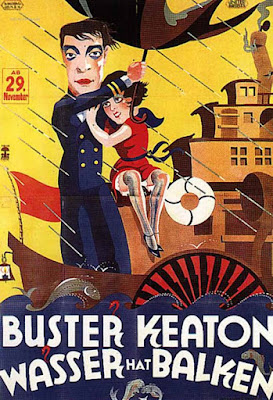
STEAMBOAT BILL, JR. (1928)

Buster Keaton’s last independent feature* is built on the double frame of feuding families (rival steamboat owners trying to stop a romance between the rich man’s daughter and Buster, the poor man’s son) and the budding relationship between pint-sized Buster and the father he never knew, jumbo-sized Ernest Torrence, the struggling steamboat man. The comedy comes in a series of gently hilarious set pieces, stand-outs include a haberdashery visit and a jail sequence where Buster demonstrates unexpected baking skills. But the film is legend for its climax, a one-reel astonishment as Buster, largely alone, confronts a hurricane as it surrealistically blasts thru town, yet still manages to save the day: both fathers, his girl and one steamboat. Complete with jaw-dropping effects that haven’t dated a bit because . . . well, because they really aren’t ‘effects,’ Buster is really doing everything. Compared to Buster’s ‘props’ and wind machines, CGI effects look bogus. And Buster goes even deeper, diving into his real-life past as a child-star vaudeville headliner when he enters a theater for a few memory turns before it self-destructs around him. (Look for his actual dad, Joseph Keaton, as a barber early in the film. Buster's ‘dive’ into the stage canvas backdrop a variation on his dad tossing him into it when he was a child as part of the act.) Buster’s feel for underlying psychology as extraordinary as it is inexplicable, like his preternatural gift for gags, stunting, narrative structure & directing technique. For nitpickers, the girl in the pic, debuting Marion Byron, doesn’t quite rate, but it’s hard to find anything else to beef about. And what a superb new score Tim Brock brings to the latest KINO DVD release, he really ‘gets’ the comedy, pointing up gags yet knowing when to be still. Essential viewing.

DOUBLE-BILL: *Buster’s last independent film, but not his last masterpiece which would be his first under contract at M-G-M, THE CAMERAMAN/’28. (With one of his best co-stars in Marceline Day.) After that, the decline was swift, accelerated by The Talkies, his drinking and (oddly enough) the financial success of those slow moving/slow-witted early sound films. Hard for Buster to argue with a slate of features that consistently outperformed his best work, like the money losing STEAMBOAT BILL, JR.

ATTENTION MUST BE PAID: Attention to your disc player since this ‘Academy Ratio’ film (4:3) is mastered on the KINO release to play correctly in the 16x9/‘Enhanced for WideScreen’ setting.

Sunday, December 23, 2018

THE BIG SLEEP (1946)

Howard Hawks’ classic pass at Raymond Chandler’s Philip Marlowe is one of the true champs of Hollywood detective pics, giving no sign of the two year struggle to get it on the screen. Dense & twisty in its details, it feels completely logical as you watch, and almost ridiculously entertaining with smart scenes & sassy dialogue constantly moving the characters and plot forward.* Humphrey Bogart, at his most resourceful & confident as Marlowe, solves the case between fending off passes from every attractive woman he comes into contact with; winding up (of course) with Lauren Bacall, the only one to give him any grief. (Off-screen, restarting their affair as Bogie’s first marriage died; wedded before reshoots.*) It’s hard to think of a crime Chandler missed sticking in here, and the film is unexpectedly violent, with corpses and compromised morals all over the place. Plus, many unexpected faces for a Warners supporting cast, all perfect . . . pretty much like the film.

ATTENTION MUST BE PAID: *William Faulkner, Leigh Brackett, Jules Furthman & an uncredited Philip Epstein (on the re-shoots) in what must be the all-time All-Star writers line-up.

DOUBLE-BILL/SCREWY THOUGHT OF THE DAY: Coming on the heels of Bacall’s smash debut (with Hawks & Bogart in TO HAVE AND HAVE NOT/’44), Jack Warner precipitously threw Bacall into CONFIDENTIAL AGENT/’45 and nearly killed her career before it got going. (It did kill the film career of B’way director Herman Shumlin on just his second pic.) Hence, reshoots to bump up the Bogie/Bacall relationship. (The drier early release now also available.)